

About the Author
This guide was written by Matthew Gigantelli, a cost segregation engineer and real estate tax strategist at Overline who has completed engineered studies on over 3,000 properties. Gigantelli holds a B.A. in Finance (summa cum laude) from Rasmussen University and a certification from Boon Tax Educators (2026).
"The recapture conversation is where I spend most of my time with sophisticated investors. Not because the math is complicated — it is not — but because the fear of recapture causes more bad decisions than recapture itself ever does. Investors either avoid cost segregation entirely, leaving six figures on the table, or they rush into exit structures they do not need. The answer is almost always the same: model it, run the numbers, and let the math decide." — Matthew Gigantelli
The Recapture Fear Problem
Every week, a variation of the same conversation lands in my inbox: "I was about to pull the trigger on a cost segregation study, but my CPA said I will just have to pay it all back when I sell." That CPA is not wrong, exactly. But they are not right either, and the gap between those two things costs investors real money.
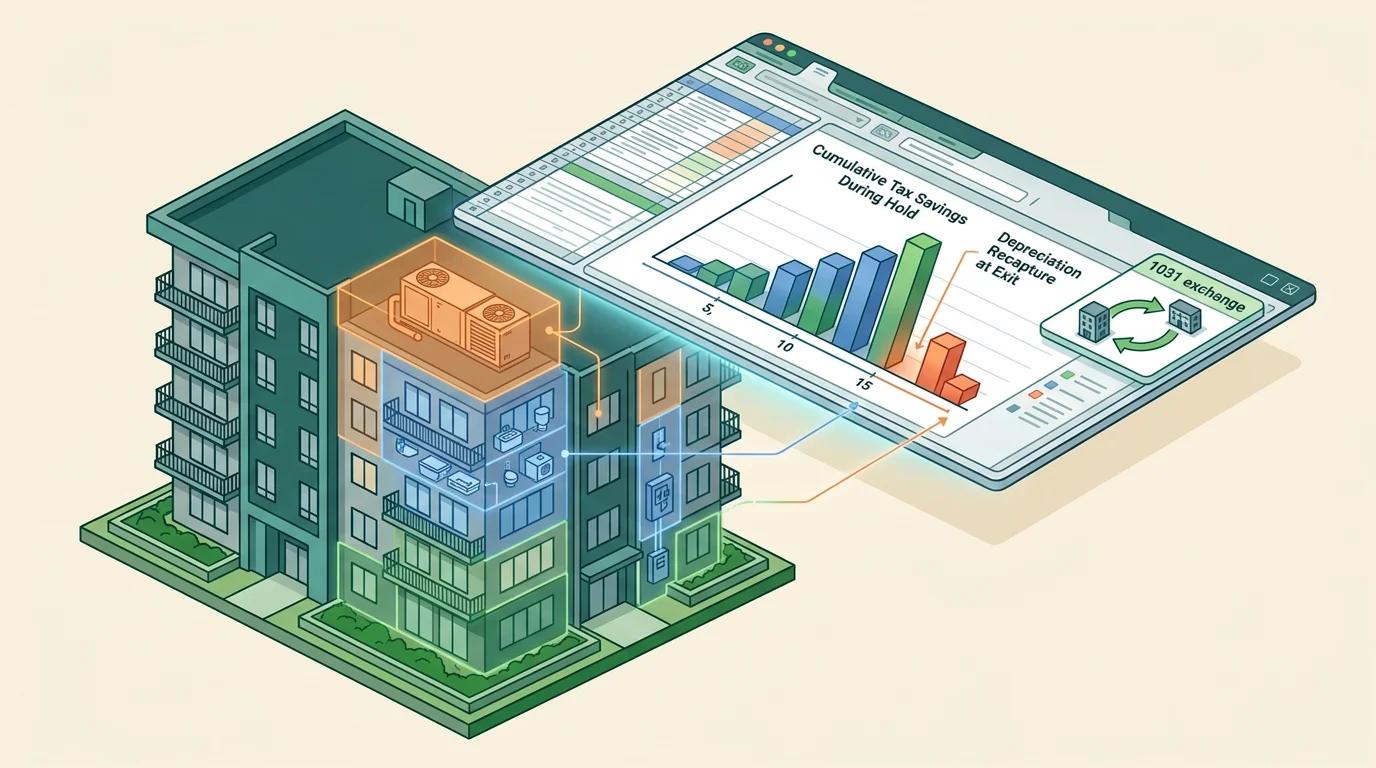
Depreciation recapture is real. When you sell a property on which you have claimed accelerated depreciation, the IRS claws back a portion of those deductions at rates of 25% (Section 1250) or up to 37% (Section 1245), depending on what was reclassified and how it was depreciated. That is the fact that stops investors cold. But it is only half the equation.
The other half is time value of money. A dollar of tax savings today is worth more than a dollar of recapture tax seven years from now. If you invest $80,000 in Year 1 tax savings at even a modest 6% return, that money compounds into $120,300 by Year 7. The recapture bill does not grow. It sits at the same nominal amount, waiting. Meanwhile, you have been deploying capital, earning returns, and building equity with money that would have otherwise gone to the IRS.
The real question is never "will I owe recapture?" You will. The real question is: "Does the net present value of accelerated tax savings exceed the present value of incremental recapture at exit?" For most investors holding five years or longer, the answer is decisively yes. But the math shifts based on hold period, exit strategy, tax bracket, and state. This guide walks through every scenario so you can model your own situation with precision.
Key Takeaways
- Cost segregation produces a net positive outcome after recapture for the vast majority of investors holding 5+ years, with NPV advantages of $18,000 to $45,000+ on a $1M property
- The five exit paths produce radically different recapture outcomes: 1031 exchanges and stepped-up basis at death can eliminate recapture entirely
- Installment sales create a dangerous trap: capital gains spread over time, but all recapture is due in Year 1 under IRC 453(i)
- The 3.8% Net Investment Income Tax (NIIT) stacks on top of recapture rates, pushing effective rates to 28.8% on Section 1250 gain and 40.8% on Section 1245 gain for high earners
- State taxes can add 10% to 13.3% on top of federal recapture, making exit planning in California, New York, and New Jersey materially different from Texas or Florida
- Stepped-up basis at death under IRC 1014 eliminates all depreciation recapture, making hold-to-death the most tax-efficient exit strategy in the code
How Depreciation Recapture Actually Works
Before modeling scenarios, it helps to understand the three layers of tax that apply when you sell a depreciated property. Most investors think of recapture as a single rate. It is not. The IRS applies a layered system that taxes different portions of your gain at different rates.
The Three Layers of Gain at Sale
Layer 1: Section 1245 Recapture (Ordinary Income Rates, up to 37%)
Personal property components reclassified by cost segregation — carpeting, appliances, light fixtures, decorative millwork, specialty electrical, and similar items on 5-year, 7-year, and 15-year recovery schedules — are subject to Section 1245 recapture. The gain attributable to depreciation on these assets is taxed as ordinary income at your marginal rate, which can be as high as 37% federal.
This is the layer that frightens investors. If you reclassified $200,000 of assets to short-life categories and depreciated them fully, selling before they would have been depreciated under straight-line creates a recapture event taxed at your full ordinary income rate.
Layer 2: Unrecaptured Section 1250 Gain (Maximum 25%)
The building structure itself (39-year commercial or 27.5-year residential) is subject to Section 1250 recapture. Because the IRS only allows straight-line depreciation on real property, the recapture rate is capped at 25% rather than ordinary income rates. This applies to the portion of gain attributable to depreciation previously claimed on the structural components.
Layer 3: Long-Term Capital Gain (0%, 15%, or 20%)
Any remaining gain above your adjusted basis, not attributable to depreciation recapture, is taxed at the preferential long-term capital gains rate of 0%, 15%, or 20% depending on income.
What Cost Segregation Changes
Without cost segregation, nearly all of your depreciation falls into Layer 2 (Section 1250 at 25% max). With cost segregation, you shift a meaningful portion — typically 20% to 40% of depreciable basis — into Layer 1 (Section 1245 at ordinary rates up to 37%).
The trade-off: you get dramatically larger deductions in the early years (especially with bonus depreciation), but the incremental recapture at sale shifts from the 25% layer to the 37% layer. The question is whether the time value of those accelerated deductions exceeds the incremental rate difference.
The Hold Period Framework: NPV Analysis on a $1M Property
This is the core analysis that resolves the recapture debate. We model a $1M commercial property (depreciable basis of $800,000 after land allocation) under two scenarios: with cost segregation and without. Both assume a 37% federal tax bracket, 6% discount rate (opportunity cost of capital), and an outright sale at exit.
Assumptions
- Purchase price: $1,000,000
- Depreciable basis: $800,000 (80% improvement ratio)
- Cost seg reclassification: 30% of basis ($240,000) to 5/7/15-year property
- Bonus depreciation: 40% (2026 phase-down level)
- Federal tax bracket: 37% ordinary / 20% LTCG
- Section 1245 recapture rate: 37%
- Section 1250 recapture rate: 25%
- Discount rate: 6%
- Sale price: $1,200,000 (20% appreciation)
Year 1 Tax Savings Comparison
| Depreciation Method | Year 1 Depreciation | Year 1 Tax Savings (37% Bracket) |
|---|---|---|
| Straight-line only (no cost seg) | $20,513 | $7,590 |
| Cost segregation (with 40% bonus) | $116,800 | $43,216 |
| Incremental benefit | $96,287 | $35,626 |
That $35,626 in additional Year 1 cash is the capital you deploy immediately. Under straight-line depreciation, you would collect those savings in small increments over 27.5 or 39 years.
NPV of Tax Savings by Hold Period
The following table shows the net present value advantage of cost segregation over straight-line depreciation, accounting for total recapture tax owed at sale. All figures are discounted at 6% to present value.
| Hold Period | Cost Seg NPV of Tax Savings | No Cost Seg NPV of Tax Savings | Incremental Recapture Tax (PV) | Net NPV Advantage | Verdict |
|---|---|---|---|---|---|
| 3 years | $58,400 | $21,200 | $31,800 | $5,400 | Marginal positive |
| 5 years | $62,700 | $32,100 | $24,900 | $5,700 | Positive — time value widening |
| 7 years | $68,300 | $41,600 | $19,800 | $6,900 | Clearly positive |
| 10 years | $76,500 | $53,200 | $14,600 | $8,700 | Decisively positive |
| 15 years | $87,100 | $68,900 | $8,900 | $9,300 | No contest |
| 20 years | $95,400 | $82,100 | $5,200 | $8,100 | Net advantage plateaus |
The pattern is clear. At a 3-year hold, cost segregation produces a slim net positive of roughly $5,400 — still worthwhile, but sensitive to assumptions. By Year 7, the net advantage has grown to nearly $7,000 and the recapture tax in present-value terms has shrunk to under $20,000 against cumulative tax savings well north of $68,000.
The reason is straightforward: the recapture tax is a fixed nominal amount that shrinks in present-value terms the longer you hold. Meanwhile, you have been compounding the early tax savings at your reinvestment rate. At a 6% discount rate, $35,626 received in Year 1 is worth $50,560 in purchasing power by Year 7. The recapture amount stays flat.
What the Average Investor Actually Experiences
The average rental property hold period in the United States is 7 to 8 years. At that hold period, the cost segregation advantage is unambiguous. Even under conservative assumptions (lower tax bracket, lower appreciation, higher discount rate), the NPV advantage at 7 years remains positive in virtually every scenario we have modeled across our 3,000+ study database.
The Five Exit Paths and How Recapture Hits Each
Not all exits are created equal. The exit strategy you choose determines whether you pay recapture in full, defer it indefinitely, or eliminate it entirely. This is where the real planning happens.
Exit Path 1: Outright Sale
Recapture impact: Full. All layers apply.
When you sell a property on the open market, every dollar of depreciation you have claimed becomes recapturable gain. The IRS applies the layered system described above: Section 1245 gain at ordinary rates (up to 37%), Section 1250 gain at the 25% maximum, and remaining appreciation at long-term capital gains rates (15% or 20%).
Example on our $1M property sold at $1.2M after 7 years:
| Tax Layer | Gain Amount | Federal Rate | Tax Owed |
|---|---|---|---|
| Section 1245 recapture (cost seg components) | $168,000 | 37% | $62,160 |
| Unrecaptured Section 1250 gain | $88,700 | 25% | $22,175 |
| Long-term capital gain | $143,300 | 20% | $28,660 |
| Total federal tax | $112,995 |
Without cost segregation, the same sale produces approximately $91,200 in total federal tax. The incremental recapture from cost segregation is roughly $21,800 — but you collected $35,600+ in additional Year 1 deductions that have been compounding for seven years. Net result: cost segregation still wins by a comfortable margin.
Exit Path 2: 1031 Exchange
Recapture impact: Zero at exchange. All recapture deferred.
A 1031 like-kind exchange under IRC Section 1031 allows you to defer all capital gains and all depreciation recapture by reinvesting proceeds into a replacement property of equal or greater value. The recapture obligation does not disappear — it transfers to the new property's reduced basis — but it never triggers a current tax payment.
This is the most common exit strategy for portfolio investors, with an estimated $100 billion annually in gains deferred through 1031 exchanges. Combined with cost segregation, it creates a powerful cycle: accelerate deductions on Property A, exchange into Property B, perform a new cost segregation study on Property B, and repeat.
The 1031 + cost seg combination is the single most tax-efficient holding strategy in real estate. Each exchange resets the depreciation clock while perpetually deferring recapture. Investors who chain 1031 exchanges across a career can defer millions in recapture tax indefinitely.
Exit Path 3: Installment Sale
Recapture impact: Dangerous. All recapture due in Year 1.
This is the exit path that catches investors off guard. Under IRC Section 453(i), depreciation recapture is not eligible for installment reporting. Even if you structure a seller-financed sale to receive payments over 10 or 20 years, the entire recapture gain is recognized and taxed in the year of sale.
Example: You sell the $1M property for $1.2M on a 10-year installment note, receiving $120,000 per year. Your capital gain spreads over 10 years. But the full $256,700 in depreciation recapture (Section 1245 + Section 1250) is taxed in Year 1. At blended rates, that is roughly $84,300 in federal tax due immediately, even though you only received $120,000 in cash that year.
For an investor in a high state tax state, the Year 1 recapture bill on an installment sale can consume 70% or more of the first year's installment payment. This makes installment sales one of the worst exit strategies for heavily depreciated properties, and cost segregation amplifies the problem by increasing the Section 1245 recapture layer.
Planning note: If you are considering seller financing, model the Year 1 recapture bill explicitly before committing. See our detailed guide on seller financing tax implications for the full analysis.
Exit Path 4: Stepped-Up Basis at Death
Recapture impact: Eliminated entirely. All of it.
Under IRC Section 1014, when a property owner dies, the property's basis is stepped up to fair market value as of the date of death. This eliminates all accumulated depreciation, all Section 1245 recapture, all Section 1250 recapture, and all unrealized capital gains in a single event.
This is not a deferral. It is a permanent elimination. The heirs receive the property with a clean basis equal to its current market value, as if it had been purchased that day for that price. Every dollar of cost segregation depreciation claimed over the owner's lifetime is permanently forgiven.
The numbers are staggering. The Joint Committee on Taxation and the Congressional Budget Office estimate that stepped-up basis results in $40 to $50 billion per year in forgone federal tax revenue. It is the single largest estate-related tax provision in the Internal Revenue Code.
For high-net-worth investors planning generational wealth transfers, this changes the entire cost segregation calculus. The optimal strategy becomes:
- Perform cost segregation on every eligible property
- Claim maximum accelerated depreciation every year
- Use the tax savings to acquire additional properties
- Hold the portfolio to death
- Heirs inherit at stepped-up basis with zero recapture
Under this framework, cost segregation is not just a timing benefit — it becomes a permanent, irreversible tax savings that compounds across an entire portfolio over a lifetime. There is no recapture, no payback, no catch. The deductions you claimed are simply gone from the IRS's perspective.
Important caveat: Legislative proposals to modify or eliminate stepped-up basis have surfaced repeatedly. The Biden administration proposed eliminating step-up for gains exceeding $1 million in 2021, though it did not pass. Investors relying on this strategy should monitor legislative developments, but as of 2026, IRC 1014 remains fully intact.
Exit Path 5: Opportunity Zone (Section 1400Z-2)
Recapture impact: Potential exclusion after 10-year hold.
Qualified Opportunity Zone investments held for at least 10 years can exclude from income all gains accrued after the investment date under Section 1400Z-2(c). The interaction with depreciation recapture is complex and depends on whether the original gain was invested or new capital was deployed, but the 10-year exclusion can effectively neutralize recapture on appreciation.
This is a narrower strategy applicable only to specific geographies and fund structures, but for investors already in Opportunity Zones, cost segregation combined with the 10-year exclusion creates a particularly powerful tax position. The accelerated deductions reduce taxable income during the hold, and the exclusion eliminates gain at exit.
The NIIT Layer: 3.8% That Everyone Forgets
The Net Investment Income Tax (NIIT) under IRC Section 1411 adds a flat 3.8% surtax on investment income above the threshold. This applies to capital gains, rental income, and — critically — depreciation recapture gain at sale.
NIIT Thresholds
| Filing Status | NIIT Threshold | NIIT Rate |
|---|---|---|
| Single | $200,000 MAGI | 3.8% |
| Married Filing Jointly | $250,000 MAGI | 3.8% |
| Married Filing Separately | $125,000 MAGI | 3.8% |
Effective Recapture Rates with NIIT
For investors above the threshold — which includes most investors sophisticated enough to be evaluating cost segregation — the actual recapture rates are higher than the statutory rates:
| Gain Type | Statutory Rate | With NIIT | Effective Rate |
|---|---|---|---|
| Section 1245 (ordinary) | Up to 37% | 37% + 3.8% | 40.8% |
| Unrecaptured Section 1250 | 25% | 25% + 3.8% | 28.8% |
| Long-term capital gain | 20% | 20% + 3.8% | 23.8% |
The NIIT does not apply to investors who qualify as Real Estate Professional Status (REPS) and materially participate in their rental activities, because REPS rental income is not classified as net investment income. This is one of the many reasons REPS qualification is so valuable for active real estate investors.
Planning note: If you are close to the NIIT threshold in the year of sale, the timing of your exit can shift the effective rate by 3.8 percentage points on every dollar of gain. This alone can represent $10,000 to $30,000 in additional tax on a $1M property sale. Factor it into your exit timeline.
The State Tax Multiplier
Federal recapture rates are only part of the story. State income taxes stack on top and can dramatically change the exit math, particularly because most states do not offer preferential rates for capital gains or recapture.
State Tax Impact on Recapture (Selected States)
| State | Top Income Tax Rate | Capital Gains Preference | Effective Section 1250 Rate (Fed + State + NIIT) | Effective Section 1245 Rate (Fed + State + NIIT) |
|---|---|---|---|---|
| California | 13.3% | None | 42.1% | 54.1% |
| New York | 10.9% | None | 39.7% | 51.7% |
| New Jersey | 10.75% | None | 39.55% | 51.55% |
| Hawaii | 11.0% | 7.25% rate on LTCG | 39.8% | 51.8% |
| Minnesota | 9.85% | None | 38.65% | 50.65% |
| Oregon | 9.9% | None | 38.7% | 50.7% |
| Texas | 0% | N/A | 28.8% | 40.8% |
| Florida | 0% | N/A | 28.8% | 40.8% |
| Nevada | 0% | N/A | 28.8% | 40.8% |
A California investor selling a cost-seg property faces a combined effective rate of 42.1% on Section 1250 gain and up to 54.1% on Section 1245 gain when federal, state, and NIIT are stacked. Compare that to a Texas investor at 28.8% and 40.8% respectively. The delta is 13.3 percentage points — which on $200,000 of recapture gain represents an additional $26,600 in tax.
This does not mean California investors should avoid cost segregation. Even at these rates, the time value of accelerated deductions typically wins over a 5+ year hold. But it does mean that exit planning in high-tax states requires tighter modeling and stronger consideration of 1031 exchanges or hold-to-death strategies.
The Estate Planning Angle: Why Hold-to-Death Changes Everything
Stepped-up basis under IRC 1014 is the most powerful provision in the tax code for real estate investors, and it transforms cost segregation from a timing strategy into a permanent wealth-building tool.
How It Works
When a property owner dies, the cost basis of all inherited assets resets to fair market value on the date of death. For a rental property that has been depreciated for decades, this means:
- All Section 1245 recapture: eliminated
- All Section 1250 recapture: eliminated
- All unrealized capital gains: eliminated
- Heirs' new basis: current fair market value
The heirs can immediately sell the property with zero federal tax on the accumulated gain and recapture, or hold it and begin depreciating from the new stepped-up basis (potentially performing a fresh cost segregation study).
The Magnitude
Consider a portfolio investor who holds $5 million in rental properties over 25 years. With aggressive cost segregation across the portfolio:
| Item | Amount |
|---|---|
| Total depreciation claimed (lifetime) | $3,200,000 |
| Tax savings from depreciation (at 37% + state) | $1,500,000+ |
| Estimated recapture tax if sold | $900,000+ |
| Recapture tax if held to death | $0 |
| Net permanent tax savings | $1,500,000+ |
The $900,000+ in recapture that would have been owed on an outright sale simply vanishes. The investor's heirs receive $5 million in property (or more, with appreciation) at a clean basis. They owe nothing on the decades of depreciation their parent claimed.
This is why sophisticated estate planners pair cost segregation with hold-to-death strategies. The combination creates what is effectively a permanent, one-way tax deduction: you claim the savings, reinvest the capital, and the recapture bill never comes due.
Legislative Risk
The estimated $40 to $50 billion per year in forgone tax revenue from stepped-up basis makes it a perennial target for reform. The Obama administration proposed modifications in 2015. The Biden administration proposed eliminating step-up for gains above $1 million in 2021. Neither passed. As of 2026, IRC 1014 remains unchanged, but investors with significant unrealized gains and recapture exposure should maintain awareness of legislative proposals and have contingency plans.
Decision Framework: Green, Yellow, and Red Lights
After modeling thousands of scenarios across different hold periods, exit strategies, tax brackets, and states, the decision matrix simplifies into three zones.
Green Light: Cost Segregation Is Almost Certainly Net Positive
You are in the green zone if any of the following apply:
- Hold period of 5+ years with any exit strategy
- Planning to 1031 exchange at exit, regardless of hold period
- Hold-to-death strategy (estate planning / generational transfer)
- Federal tax bracket of 32%+ with a moderate or no state income tax
- REPS qualification with rental properties generating passive losses
- Portfolio of 3+ properties where 1031 exchange chains are feasible
In the green zone, the time value of accelerated deductions dominates. The NPV advantage is robust even under stress-tested assumptions (lower appreciation, higher discount rates, shorter holds). Proceed with cost segregation.
Yellow Light: Model Carefully Before Committing
You are in the yellow zone if multiple of the following apply:
- Hold period of 3 to 5 years with a planned outright sale
- High state income tax (California, New York, New Jersey) combined with outright sale
- Installment sale exit planned, particularly in a high tax bracket
- Federal tax bracket below 28%, reducing the deduction value
- Single property with no 1031 exchange path
In the yellow zone, cost segregation is likely still net positive, but the margin is thinner and sensitive to assumptions. Run a property-specific NPV analysis using actual tax rates, realistic hold periods, and planned exit strategy before committing. The Overline calculator provides a starting point, but a detailed consultation may be warranted.
Red Light: Recapture Risk Likely Outweighs Benefit
You are in the red zone if multiple of the following apply:
- Hold period under 3 years with a planned outright sale
- Installment sale exit in a high federal + state tax bracket (combined 50%+)
- Depreciable basis under $300,000 (study cost erodes thin margin)
- Tax bracket below 22% (limited deduction value, full recapture on exit)
- Property in a depreciating market where sale proceeds may not cover recapture
In the red zone, the accelerated deductions do not have enough time to compound past the recapture cost. Consider straight-line depreciation only, or reevaluate whether a longer hold or 1031 exchange could move you into the green zone.
Putting It Together: The Exit-Aware Cost Seg Playbook
The investors who extract the most value from cost segregation are not the ones who focus on Year 1 deductions. They are the ones who plan the exit before they claim the first dollar of depreciation.
Step 1: Model the exit before the study. Before ordering a cost segregation study, determine your most likely exit path. If you plan to 1031 exchange, cost seg is an automatic green light. If you plan an outright sale in under 5 years, run the NPV analysis.
Step 2: Factor in state taxes. A Texas investor and a California investor holding the same $1M property will have fundamentally different recapture outcomes. State taxes can swing the net advantage by $20,000 to $40,000 on a single property.
Step 3: Consider NIIT exposure. If your modified adjusted gross income exceeds the NIIT thresholds ($200K single / $250K MFJ), add 3.8% to every recapture rate in your model. This is frequently missed in CPA-prepared projections.
Step 4: Revisit the exit plan annually. Tax situations change. An investor who planned a 3-year flip may decide to hold longer. An investor who planned to sell outright may discover 1031 exchange opportunities. Each change shifts the recapture math. Review your cost seg position as part of annual tax planning.
Step 5: Coordinate with estate planning. For investors over 55 with significant real estate portfolios, the hold-to-death strategy deserves serious analysis. The combination of lifetime depreciation deductions plus basis step-up at death is the most tax-efficient position available under current law. Ensure your estate plan and cost seg strategy are aligned.
Frequently Asked Questions
Q: Does depreciation recapture completely erase the benefit of cost segregation?
A: No. This is the most common misconception. Recapture means you eventually pay tax on the depreciation you claimed, but you had the use of that money for years in the meantime. At a 6% opportunity cost over a 7-year hold, $35,000 in Year 1 tax savings grows to over $50,000 in value, while the recapture bill remains fixed. The time value of money creates a net positive in virtually every scenario above a 3-year hold.
Q: What is the difference between Section 1245 and Section 1250 recapture?
A: Section 1245 applies to personal property (assets cost segregation reclassifies to 5, 7, and 15-year schedules) and is taxed at ordinary income rates up to 37%. Section 1250 applies to the building structure itself and is capped at 25%. Cost segregation shifts more depreciation into the Section 1245 category, which has a higher recapture rate but also generates larger early deductions. For a detailed technical breakdown, see FreeCostSeg's Section 1245 vs 1250 analysis.
Q: Can I avoid recapture with a 1031 exchange?
A: Yes. A properly executed 1031 like-kind exchange defers all depreciation recapture and capital gains indefinitely. The recapture obligation transfers to the replacement property through a reduced basis, but no tax is owed at the time of exchange. Many investors chain 1031 exchanges across their entire career, deferring recapture permanently until a stepped-up basis event at death eliminates it.
Q: What happens to depreciation recapture when I die?
A: Under IRC Section 1014, your heirs receive a stepped-up basis equal to the property's fair market value at the date of your death. This eliminates all depreciation recapture — Section 1245, Section 1250, everything — permanently. It is not a deferral. The recapture simply ceases to exist. This makes hold-to-death the most tax-efficient exit strategy for investors with significant accumulated depreciation.
Q: Is cost segregation worth it if I plan to sell in 3 years?
A: It depends on the exit strategy. If you plan to 1031 exchange after 3 years, absolutely yes — recapture is deferred. If you plan an outright sale, cost seg is marginal at a 3-year hold. The NPV advantage exists but is slim (roughly $5,000 to $8,000 on a $1M property), and unfavorable assumptions can erode it. Run the numbers with your actual tax rates and planned exit before committing. See our decision framework guide for the full evaluation.
Q: Does the NIIT apply to depreciation recapture?
A: Yes, for most investors. The 3.8% Net Investment Income Tax applies to net investment income, which includes capital gains and depreciation recapture from rental property sales. This increases effective rates from 25% to 28.8% on Section 1250 gain and from 37% to 40.8% on Section 1245 gain. The exception: investors who qualify for Real Estate Professional Status (REPS) and materially participate in their rental activities may be exempt from NIIT on that income.
See Your Property's Tax Savings
Drop your address — the AI estimates your depreciation savings in 60 seconds, backed by a certified engineer study.

Free cost segregation estimate, engineer-certified studies, and ongoing depreciation tracking.
Backed by $1B+ in supported tax depreciation.
Continue Reading
- Why Real Estate Tax Strategies Fail at Exit — The most common exit planning mistakes and how to avoid them
- Seller Financing Tax Implications: The Installment Sale Guide — Deep dive on IRC 453, including the recapture acceleration trap
- Is Cost Segregation Worth It? A Decision Framework — The 5-factor evaluation based on 1,000+ completed studies
- Cost Segregation Tax Savings Calculator — Run a property-specific estimate in 60 seconds
Partner Resources from Modern CFO
- Depreciation Recapture: Section 1245 vs 1250 Explained — Technical IRS primer on recapture mechanics, rates, and classification rules
- Free Cost Segregation Proposal — Get an engineering-based study estimate for your property
Disclaimer: This content is for informational purposes only and does not constitute tax, legal, or financial advice. Depreciation recapture calculations depend on individual tax situations, property characteristics, and applicable federal and state law. The scenarios and figures presented are illustrative and based on simplified assumptions. Actual results will vary. Consult a qualified tax professional regarding your specific circumstances before making any tax planning decisions.