

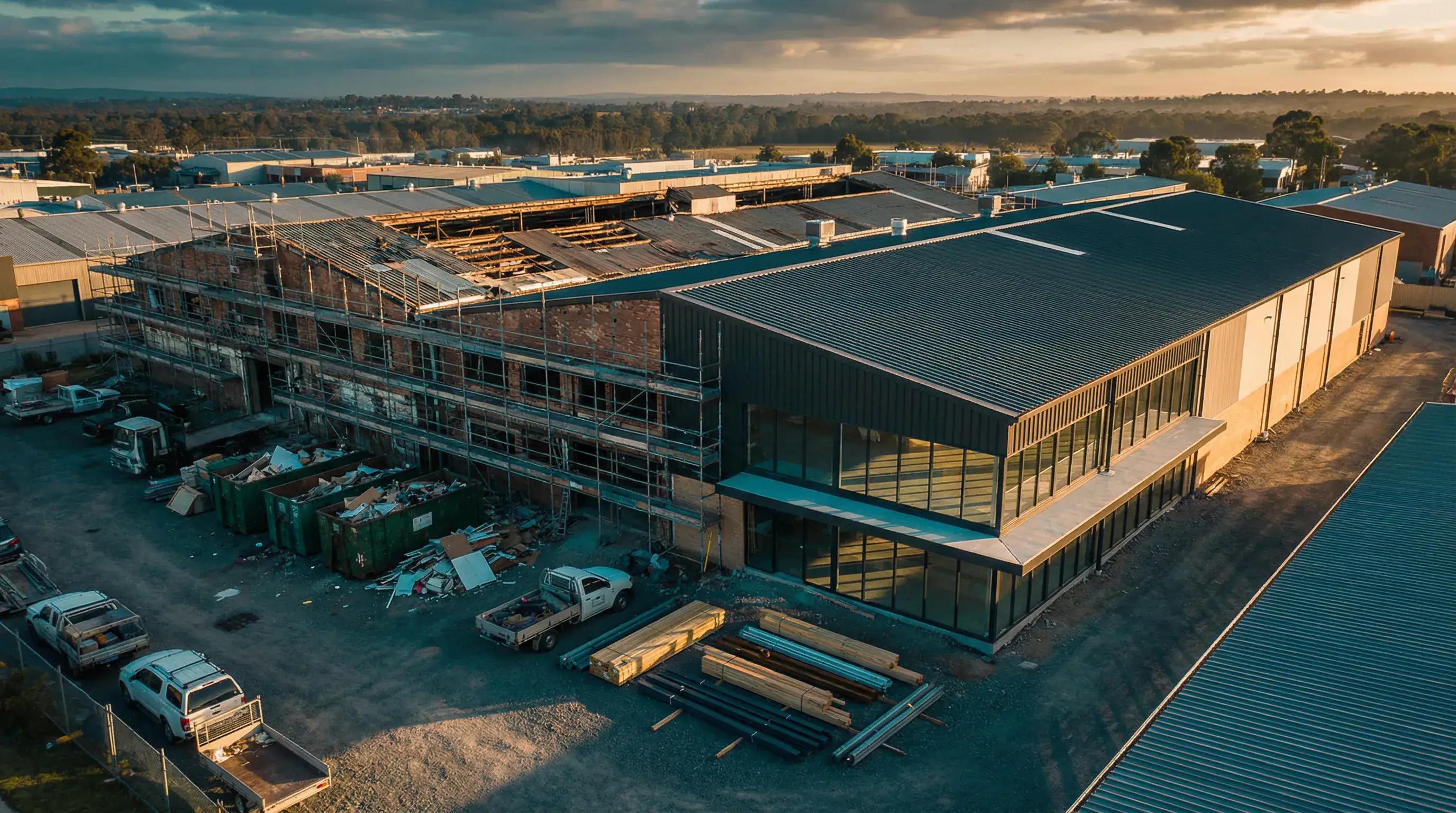
I just spent 90 minutes on the phone with the person who helped write the IRS rulebook on Section 179D.
James C. Peacock spent 38.5 years at the IRS as a General Engineer and served as the agency's primary technical expert on Section 179D from 2014 through his retirement in September 2025. He developed the IRS Section 179D Practice Unit from its first release in 2018 and updated it through 2025. When there was a question about how 179D worked, James was the person the IRS called.
He told me something that every commercial building owner, designer, and energy services contractor needs to hear right now.
The June 30, 2026 deadline is real. But it is not what most people think it is.
Quick Answer: Section 179D eligibility in 2026 turns on construction commencement, not placed-in-service date. Projects that began before June 30, 2026 can still qualify even if completed in 2027 or 2028. The 2026 deduction ranges from $0.59 to $1.19 per square foot, or $2.97 to $5.94 with prevailing wage compliance.
What the One Big Beautiful Bill Changed
When President Trump signed the One Big Beautiful Bill into law on July 4, 2025, most of the attention went to 100% bonus depreciation made permanent for property acquired after January 19, 2025. That was a massive win for real estate investors and businesses alike.
What got less attention was what happened to Section 179D.
The OBBB eliminated the Section 179D deduction for projects beginning construction after June 30, 2026. Congress drew a hard line. New projects starting July 1, 2026 or later will not qualify for the deduction, at least under current law.
But here is the part that matters right now: the statute uses construction commencement as the qualifying event. Not placed-in-service date. Not completion date. Not occupancy date.
If your project broke ground before June 30, 2026, you are in.
The Construction Commencement Rule: How It Works
James was direct about this when I asked him to explain the mechanics.
"The qualifying event for 179D is when construction begins, not when the building is placed in service," he told me. "A project that starts construction before June 30, 2026 can still claim the deduction even if it isn't finished until 2027 or 2028."
This is not a loophole or an aggressive interpretation. It is the plain language of the statute, consistent with how James applied it during his 11 years as the IRS's 179D subject matter expert.
What counts as "beginning construction"? Physical work of a significant nature on the project site. This aligns with definitions used across the tax code for energy-related provisions. Signing a contract is not enough. Pulling permits may not be enough on its own. But actual site work, including foundation work, structural framing, or major mechanical rough-in, generally meets the threshold.
If you have a project currently under construction that started before the end of June, document it. Photographs with timestamps. Contractor payment applications. Site inspection reports. Permit dates. This documentation becomes the foundation of your 179D claim.
Why Placed-in-Service Date Does Not Determine Eligibility
This is the single most common misconception about the June 30 deadline.
Real estate professionals are used to thinking about placed-in-service dates because that is the trigger for most depreciation deductions. Bonus depreciation, Section 179, cost segregation benefits, QIP treatment, all of these flow from when a property is placed in service.
Section 179D works differently. The deduction is claimed in the year the property is placed in service, but eligibility is determined by when construction began.
James explained it this way during our conversation: "179D has always had its own rules separate from cost segregation. The IRS Practice Unit I developed made this clear. The energy efficiency standards, the building use test, the prevailing wage requirements, and the construction commencement rule all work together as a distinct framework."
So a building that starts construction in May 2026 and is placed in service in March 2027 still qualifies for 179D under 2026 law. The deduction is taken on the 2027 tax return, but eligibility was locked in at construction commencement.
How Section 179D Differs from Cost Segregation
James was careful to draw a clear line between these two strategies because investors often conflate them.
Cost segregation is an engineering study that reclassifies building components into shorter depreciation categories. The benefit flows entirely from accelerated depreciation, and the IRS Cost Segregation Audit Techniques Guide governs how studies are evaluated. As James put it throughout our conversation: "It's the support, not the report." The quality of the underlying engineering and documentation determines defensibility.
Section 179D is a different animal entirely. Here are the key differences:
Energy efficiency standard. 179D requires the building to meet specific energy efficiency thresholds compared to a reference building under ASHRAE standards. A qualified energy modeler must certify the results using approved software. Cost segregation studies say nothing about energy performance.
Prevailing wage requirement. Under post-IRA rules, projects must meet prevailing wage requirements to claim the maximum deduction. This adds a compliance layer that cost seg does not have.
Building use test. 179D applies to commercial buildings and certain multifamily properties, with specific rules around who can claim the deduction. For government-owned buildings, the deduction is allocated to the designer (architect, engineer, or contractor) rather than the building owner. This designer allocation rule is one of the most underutilized provisions in the entire deduction.
Deduction amount. The 2026 179D deduction is $0.59 to $1.19 per square foot under the standard rate, or $2.97 to $5.94 per square foot for projects meeting prevailing wage requirements. For a 100,000 square foot commercial building, that is up to $594,000. Cost segregation produces depreciation reclassification, not a direct deduction.
Who can claim it. Building owners can claim 179D for their own commercial buildings. For government-owned buildings, public schools, and similar properties, the deduction passes to the designer who made the energy-efficient design possible. ESCOs (energy service companies), architects, and engineers do significant volume of 179D work under this provision.
These strategies are not mutually exclusive. Many commercial building projects benefit from both: 179D for the energy efficiency deduction, cost segregation for accelerated depreciation on components. But they have separate rules, separate documentation requirements, and separate IRS oversight mechanisms.
Who Still Qualifies: The Full Picture
If your project commenced construction before June 30, 2026, here is who can still claim 179D:
Commercial building owners. Any owner of a commercial building where the energy-efficient systems (HVAC, lighting, building envelope) meet the required thresholds. This includes office buildings, retail centers, industrial facilities, hotels, and multifamily buildings of three stories or more.
Designers of government-owned buildings. Architects, engineers, mechanical contractors, and ESCOs who designed energy-efficient buildings owned by federal, state, or local government. This is a significant revenue opportunity that many design firms still do not know exists.
Energy service contractors. ESCOs that retrofit existing commercial buildings with qualifying energy-efficient systems. The retrofit has to be substantial enough to meet the energy performance threshold relative to the original building.
Real estate developers. Ground-up commercial construction projects that started before June 30, 2026 qualify even if the building will not be completed for another 18 to 24 months.
The key question in every case is the same: did construction begin before June 30, 2026? If yes, document it now. If the project is in the planning phase and has not broken ground, the window has closed.
What James Said About Reinstatement
I asked James directly whether he thinks Congress will bring 179D back.
"Usually the popular deductions come back," he told me. "Bonus depreciation is a good example. It started at 30 percent after 9/11 and eventually became 100 percent permanent. When Congress sees that a provision is widely used and generates economic activity, they tend to restore it."
James is not making a promise. He is drawing on 38.5 years of watching tax provisions cycle through Congress. The pattern is real. Bonus depreciation was introduced at 30% under the Job Creation and Worker Assistance Act of 2002 as a temporary measure. It was expanded, phased down, phased back up, and finally made permanent in the OBBB at 100%. The political economy of business tax incentives tends to favor restoration.
That said, James was also clear about what it means for right now: "You should not wait on Congress. If your project qualifies today, claim it today. You can always amend a return or file a superseding claim if the law changes, but you can't retroactively begin construction after the deadline has passed."
This is exactly the right frame. Lock in eligibility now. If Congress restores 179D for future construction, that is a future benefit. The June 30 window is closed for new projects regardless of what happens next.
The IRS Technical Framework James Built
James developed the IRS Section 179D Practice Unit, the internal guidance document IRS engineers and revenue agents use when examining 179D claims. He released the first version in 2018 and updated it through 2025, including a significant update in that final year before his retirement.
He also contributed to the Cost Segregation Audit Techniques Guide starting with its development in 2000 through 2002, its public release in 2004, and every major update since, including the February 2025 update. He was among the first IRS engineers to examine cost segregation studies.
When James talks about what the IRS looks for in a 179D claim, he is describing what he personally built into the examination framework.
The documentation requirements for 179D are specific:
Energy modeling certification. A qualified certifier must use IRS-approved software to model the building's energy performance and certify it meets the threshold. This is not optional. Without certification, there is no deduction.
As-built documentation. The certification has to be based on the actual building as constructed, not design intent. Changes during construction that affect energy performance need to be reflected in the final certification.
Prevailing wage records. For projects claiming the enhanced deduction rate, payroll records demonstrating compliance with prevailing wage requirements need to be maintained. This was added by the Inflation Reduction Act and carried forward under current law.
Construction commencement evidence. For projects claiming the deduction under the pre-June 30 commencement rule, documentation of when construction actually began becomes part of the 179D file.
James applied the same principle to 179D that he used throughout his cost segregation work: "It's the support, not the report." The certification document is the report. The underlying site records, energy models, contractor documentation, and prevailing wage records are the support. The IRS will ask for both.
Common 179D Mistakes That Kill Claims
Based on James's framework and the IRS examination patterns he built:
Claiming 179D on residential property. Section 179D applies to commercial buildings and multifamily residential of three stories or more. Single-family rentals, duplexes, and small multifamily do not qualify. Short-term rentals under 30-day average stay are treated as 39-year non-residential property for other purposes, but 179D eligibility still turns on commercial vs. residential classification.
Using unqualified certifiers. The certifier has to be an independent qualified person as defined in the regulations. The building owner's own tax advisor cannot self-certify. The certifier must have the required credentials and must use approved software.
Missing the energy performance threshold. The building or system must achieve a specific percentage reduction in energy cost compared to the ASHRAE reference building. Partial improvements that don't hit the threshold produce nothing. You need to model before you commit to the deduction.
Ignoring prevailing wage compliance. Projects claiming the full deduction rate that cannot document prevailing wage compliance will be adjusted down to the reduced rate. This is a significant difference: up to $5.94 per square foot versus $1.19 per square foot in 2026. For a large building, the gap is hundreds of thousands of dollars.
Failing to document construction commencement. For projects relying on the pre-June 30 commencement rule, undocumented start dates create an examination risk. If the IRS asks when construction began, you need contemporaneous evidence, not a contractor's recollection two years later.
What to Do Right Now
If you have a commercial construction project that started before June 30, 2026, take these steps immediately.
Gather commencement documentation. Pull the earliest contractor payment application, the initial site work permit, first site inspection report, and any photographs with embedded timestamps from the job site. Create a file specifically for 179D commencement documentation.
Engage a qualified certifier now. Do not wait until the building is complete. A qualified energy modeler can review the design documents and projected energy performance to estimate whether the building will qualify. If there are design changes you can make now that improve eligibility, you want to know before construction is too far along.
Confirm prevailing wage compliance is tracked. If your project qualifies, the difference between the standard rate and the prevailing wage rate is substantial. Make sure your general contractor and subcontractors are documenting wage compliance on an ongoing basis.
Talk to your tax advisor about the interplay with cost segregation. If the building also qualifies for cost segregation, coordinate the timing of both studies. The 179D certification needs to happen before or at placed-in-service. Cost segregation can be done at the same time or shortly after. Many cost seg providers can handle both or refer you to a certified 179D provider. For guidance on choosing the right provider, see our review of how to choose a cost segregation provider.
If you own existing commercial buildings, look at retrofit opportunities. The June 30 deadline applies to new construction commencement, but existing commercial buildings with energy-efficient upgrades can qualify if the retrofit itself commenced before June 30. An HVAC replacement project or lighting retrofit that started before the deadline may still be in the window.
For Designers: The Government Building Allocation
One of the most overlooked provisions in Section 179D is the designer allocation for government-owned buildings. If you are an architect, engineer, mechanical contractor, or ESCO that designed or built energy-efficient improvements to a government-owned building, you can claim the 179D deduction even though you do not own the building.
This is because government entities are tax-exempt and cannot use the deduction themselves. Congress transferred it to the qualifying designer as an incentive for energy-efficient government construction.
"The designer allocation was a deliberate policy choice to encourage private-sector designers to push energy efficiency in government projects," James explained. "The IRS Practice Unit I developed covers this in detail because it is one of the more complex aspects of the provision."
For design firms doing significant volume of government and public school work, the amounts add up quickly. A 200,000 square foot school building at $5.94 per square foot is up to $1.188 million in potential deductions allocated to the designer.
If your firm has done government work over the past few years on projects that commenced construction before June 30, 2026, there may be unclaimed 179D deductions sitting on the table.
The Bigger Picture: Cost Segregation Stays Intact
The OBBB's treatment of 179D did not affect cost segregation. Bonus depreciation is now permanent at 100%. Cost segregation combined with 100% bonus depreciation for property acquired after January 19, 2025 is the most powerful first-year depreciation combination available to commercial real estate investors.
The elimination of 179D for new construction starting July 1, 2026 is a setback, but it is a specific provision with a specific qualifying event. It does not change the fundamental math on cost segregation for properties placed in service with qualifying construction.
For investors trying to understand whether cost segregation still makes sense for their projects, the analysis is largely the same as it was before: does the property have components that qualify for shorter depreciation lives, and does the time value of the accelerated deductions justify the cost of a study? For most commercial properties and multifamily assets above a certain size, the answer is still yes. See our analysis of whether cost segregation is worth it for a detailed breakdown.
The other important point: cost segregation studies done correctly remain defensible under IRS examination. James spent nearly four decades examining them. The standard he applied was always the same. Legitimate studies that follow IRS guidelines hold up in audit. The ones that do not are usually discovered not because cost seg triggers scrutiny, but because other issues open a return for examination. For more on audit risk specifically, FreeCostSeg has a detailed breakdown of what actually triggers IRS review.
The Bottom Line
The June 30, 2026 deadline for Section 179D is a construction commencement deadline, not a placed-in-service deadline.
Projects that broke ground before June 30, 2026 remain eligible for the 179D deduction even if they are not complete until 2027 or 2028. The deduction is claimed in the year the building is placed in service, but eligibility was determined by when construction started.
James Peacock, the person who literally wrote the IRS's internal guidance on this provision, confirmed the rule and its logic. If you have a qualifying project underway, document the commencement date now, engage a qualified certifier, and make sure prevailing wage compliance is being tracked.
If your project has not yet started, the window is closed. But watch for Congressional action. James's read, after nearly four decades watching the tax legislative cycle, is that popular energy provisions tend to come back. Bonus depreciation started at 30% in 2002. It is permanent at 100% today.
The right move is to capture what you qualify for under current law and position yourself to benefit if the provision is restored.
For a free estimate on your property's cost segregation potential, visit FreeCostSeg.com.
About the Expert
James C. Peacock spent nearly 39 years at the IRS as a General Engineer and Subject Matter Expert in the LB&I Division. He was among the first IRS engineers to examine cost segregation, contributed to the Cost Segregation Audit Techniques Guide from 2004 through the 2025 update, and served as the IRS's primary technical expert on Section 179D from 2014 through his retirement in September 2025. He developed and updated the IRS Section 179D Practice Unit from its first release in 2018 through 2025. Per James, he also trained approximately 200 new-hire IRS engineers on cost segregation and 179D before retiring. He holds a degree in Architectural Engineering from The University of Texas at Austin (1983) and founded J Peacock Cost Seg Advisors LLC after leaving the IRS.
