

The Simplest Tax Decision Most Property Owners Get Wrong
Every property owner in America depreciates their buildings. It's not optional — the IRS requires it.
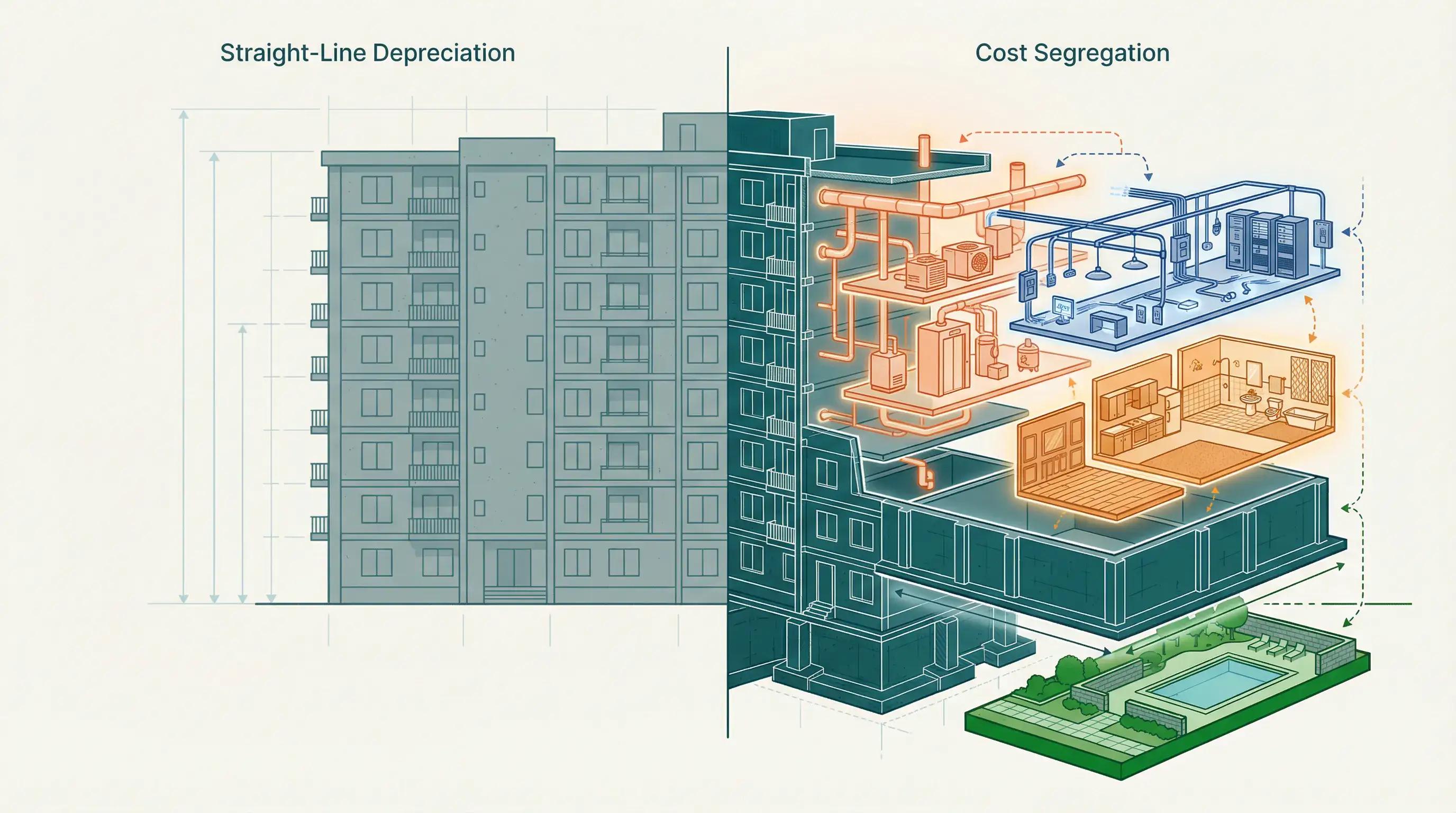
The question is how you depreciate: the default method (straight-line) or the optimized method (cost segregation).
The default costs you tens of thousands of dollars in delayed deductions. And most property owners never realize it because they never see the comparison.
This guide shows you that comparison — in plain numbers, property by property — so you can make an informed decision.
Author's note (Overline): We've run this exact comparison on 1,000+ properties. In almost every case above $300K in depreciable basis, cost segregation significantly outperforms straight-line depreciation. The exceptions are specific and predictable — we'll show you those too.
How Straight-Line Depreciation Works
Straight-line depreciation is the default method under IRC §168(b)(3). It's simple: take your depreciable basis and divide it evenly over the building's useful life as defined by the Modified Accelerated Cost Recovery System (MACRS):
- Residential rental: 27.5 years (IRC §168(c))
- Commercial property: 39 years (IRC §168(c))
Example: You buy a $1M commercial building (excluding land). Straight-line depreciation gives you $25,641 per year for 39 years. At a 35% tax bracket, that's $8,974 per year in tax savings.
Simple. Predictable. And dramatically suboptimal.
How Cost Segregation Works
Cost segregation breaks the building into its individual components and assigns each one the correct depreciation schedule under IRC §168(a) and Treasury Regulation §1.167(a)-4 (which permits component depreciation):
- 5-year property (IRC §168(e)(3)(B)): Carpeting, appliances, cabinets, specialty electrical, decorative fixtures, movable partitions
- 7-year property (IRC §168(e)(3)(C)): Office furniture, certain equipment
- 15-year property (IRC §168(e)(3)(E)): Landscaping, parking lots, fencing, sidewalks, exterior lighting
- 27.5/39-year property: Building structure (foundation, walls, roof, permanent HVAC)
With 100% bonus depreciation for property acquired after January 19, 2025 (reinstated in 2025), all 5-year, 7-year, and 15-year property can be deducted entirely in Year 1.
Same building. Same purchase price. Dramatically different Year-1 deduction.
The Side-by-Side Comparison
$750K Single-Family Rental
| Straight-Line | Cost Segregation | |
|---|---|---|
| Depreciable basis | $562K | $562K |
| Year-1 deduction | $20,436 | $168,600 |
| Tax savings, Year 1 (35%) | $7,153 | $59,010 |
| 5-year cumulative deductions | $102,182 | $255,345 |
| 5-year cumulative tax savings | $35,764 | $89,371 |
| Difference (5 years) | — | +$53,607 |
Assumes 30% reclassification to 5/15-year property, 100% bonus depreciation for property acquired and placed in service after January 19, 2025, land value 25%.
$1.5M Apartment Building (8 Units)
| Straight-Line | Cost Segregation | |
|---|---|---|
| Depreciable basis | $1.125M | $1.125M |
| Year-1 deduction | $40,909 | $382,500 |
| Tax savings, Year 1 (35%) | $14,318 | $133,875 |
| 5-year cumulative deductions | $204,545 | $540,000 |
| 5-year cumulative tax savings | $71,591 | $189,000 |
| Difference (5 years) | — | +$117,409 |
Assumes 34% reclassification, 100% bonus depreciation for property acquired and placed in service after January 19, 2025, land value 25%.
$3M Office Building
| Straight-Line | Cost Segregation | |
|---|---|---|
| Depreciable basis | $2.4M | $2.4M |
| Year-1 deduction | $61,538 | $768,000 |
| Tax savings, Year 1 (35%) | $21,538 | $268,800 |
| 5-year cumulative deductions | $307,692 | $1,104,000 |
| 5-year cumulative tax savings | $107,692 | $386,400 |
| Difference (5 years) | — | +$278,708 |
Assumes 32% reclassification, 100% bonus depreciation for property acquired and placed in service after January 19, 2025, land value 20%.
$10M Hotel
| Straight-Line | Cost Segregation | |
|---|---|---|
| Depreciable basis | $8M | $8M |
| Year-1 deduction | $205,128 | $3,040,000 |
| Tax savings, Year 1 (35%) | $71,795 | $1,064,000 |
| 5-year cumulative deductions | $1,025,641 | $4,160,000 |
| 5-year cumulative tax savings | $358,974 | $1,456,000 |
| Difference (5 years) | — | +$1,097,026 |
Assumes 38% reclassification, 100% bonus depreciation for property acquired and placed in service after January 19, 2025, land value 20%.
For detailed savings data by every property type, see our complete guide: How Much Does Cost Segregation Save?
The Time Value of Money: Why "Same Total Depreciation" Misses the Point
A common objection: "Cost segregation doesn't create new deductions — it just moves them earlier. The total is the same."
That's technically true. And completely irrelevant. Here's why:
A dollar saved in taxes today is worth more than a dollar saved in 20 years. This is the fundamental principle of time value of money.
| When You Get $100K in Tax Savings | Present Value (at 7% discount rate) |
|---|---|
| Year 1 (with cost segregation) | $100,000 |
| Spread over 27.5 years (straight-line) | ~$54,000 |
| Spread over 39 years (straight-line) | ~$42,000 |
The same $100K in total deductions is worth nearly 2.4x more when accelerated to Year 1 vs. spread over 39 years.
That's before considering what you can do with the cash: reinvest in another property, pay down debt, or fund other investments that compound over time.
When Does Cost Segregation NOT Make Sense?
Cost segregation isn't right for every situation. Here's when straight-line might be the better choice:
| Situation | Why Straight-Line May Be Better |
|---|---|
| Property under $300K depreciable basis | Study cost may eat too much of the savings |
| Selling within 12 months | Depreciation recapture reduces the benefit |
| Tax-exempt entity | No taxable income to offset |
| Very low tax bracket (12-15%) | Savings are smaller; may benefit more from future higher-bracket deductions |
| Property with minimal personal property | Some buildings (empty warehouses, raw land improvements) have less to reclassify |
For most properties above $300K in depreciable basis owned by investors in the 32%+ bracket, cost segregation is the clear winner. Use our decision framework for a detailed analysis of your specific situation.
With Overline's pricing starting at $1k, the threshold where cost segregation makes economic sense is significantly lower than with traditional firms charging $5,000+.
What About Depreciation Recapture?
When you sell the property, you'll owe depreciation recapture tax under IRC §1245 (personal property, taxed as ordinary income) and IRC §1250 (real property, capped at 25%) on the accelerated depreciation. This is the cost of front-loading deductions.
But the math still overwhelmingly favors cost segregation:
| Factor | Impact |
|---|---|
| Time value | Years of compounding on Year-1 tax savings far exceed recapture cost |
| 1031 exchange (IRC §1031) | Defers recapture entirely if you exchange into like-kind property (Treasury Reg. §1.1031(a)-1) |
| Stepped-up basis at death (IRC §1014) | Eliminates recapture entirely — heirs inherit at current market value |
| Rate differential | You deducted at 35-37% ordinary rates; §1250 recapture is capped at 25% |
Example: You save $80K in Year 1 from cost segregation. You invest that at 7% annual return. After 10 years, it's worth ~$157K. When you sell and pay 25% recapture on the accelerated portion, you owe ~$57K in additional recapture tax. Net benefit: ~$100K better off than straight-line — even after recapture.
Quick Decision Guide
| Your Situation | Best Approach |
|---|---|
| Property $500K+, 32%+ tax bracket, hold 3+ years | Cost segregation — clear winner |
| Property $300K–$500K, 30%+ bracket | Cost segregation — likely worth it at Overline pricing |
| Property under $300K, any bracket | Run the calculator first — may be marginal |
| Selling within 1 year | Straight-line — recapture erases benefit |
| Tax-exempt entity | Straight-line — no tax to offset |
| W-2 earner using STR loophole | Cost segregation — highest ROI scenario |
Not sure? Run the free calculator for a property-specific comparison in 60 seconds. You can also try Modern CFO's free calculator for an instant side-by-side estimate of your potential savings.
Frequently Asked Questions
Q: Is the total depreciation the same with both methods? A: Yes — cost segregation doesn't create additional depreciation. It accelerates when you take it. The total lifetime depreciation equals your depreciable basis regardless of method. The value comes from taking larger deductions sooner, when the tax savings are worth more.
Q: Can I switch from straight-line to cost segregation on a property I already own? A: Yes. You can perform a "look-back" cost segregation study on any property you currently own and catch up on missed accelerated depreciation through a Form 3115 (change in accounting method). The cumulative missed depreciation is claimed in a single year — no need to amend prior returns. This is often the highest-ROI application of cost segregation.
Q: Does my CPA need to approve the switch? A: Your CPA needs to process the cost segregation study and file the appropriate depreciation schedules. The Form 3115 for a look-back study is filed with that year's return. Most CPAs can handle this, but confirm they have experience with cost segregation filings specifically.
Q: What if bonus depreciation isn't available in the future? A: Even without bonus depreciation, cost segregation is valuable. Reclassified 5-year property depreciates in 5 years instead of 27.5 or 39 years, that acceleration creates significant present-value benefits. The 100% allowance for property acquired and placed in service after January 19, 2025 amplifies that benefit by allowing Year-1 full deduction, but it's not required for cost segregation to be worthwhile. The 100% allowance has no scheduled end date: Public Law 119-21 struck the termination clause outright, so there is no "available through" year to plan around. See our bonus depreciation guide.
Q: How much does a cost segregation study cost compared to the savings? A: Traditional firms charge $5,000–$60,000+. Overline delivers the same IRS-compliant quality starting at $1k. For a $750K property, cost segregation typically saves $50,000–$60,000 in Year-1 taxes. Even at traditional pricing, the ROI is 8x-15x. Through Overline, it's 30x-100x+.
See Your Property's Tax Savings
Drop your address. The AI estimates your depreciation savings in 60 seconds, backed by a certified engineer study.

Free cost segregation estimate, engineer-certified studies, and ongoing depreciation tracking.
Backed by $1B+ in supported tax depreciation.
Continue Reading
Explore more guides from our library:
- How Much Does Cost Segregation Save? — Detailed savings by every property type
- Is Cost Segregation Worth It? — Decision framework based on 1,000+ studies
- One Big Beautiful Bill: 100% Bonus Depreciation for Property Acquired After January 19, 2025, Current bonus depreciation rules
- Cost Segregation for W-2 Earners — How high-income professionals maximize savings
- Cost Segregation Audit Risk — What actually triggers IRS scrutiny
For deeper technical analysis on cost segregation strategies, see Modern CFO's depreciation comparison guide.
Disclaimer: This content is for informational purposes only and does not constitute legal, tax, or financial advice. Depreciation calculations are illustrative and based on simplified assumptions. Actual results vary based on property condition, purchase date, applicable tax rates, and individual circumstances. Consult qualified tax professionals regarding your specific situation.