

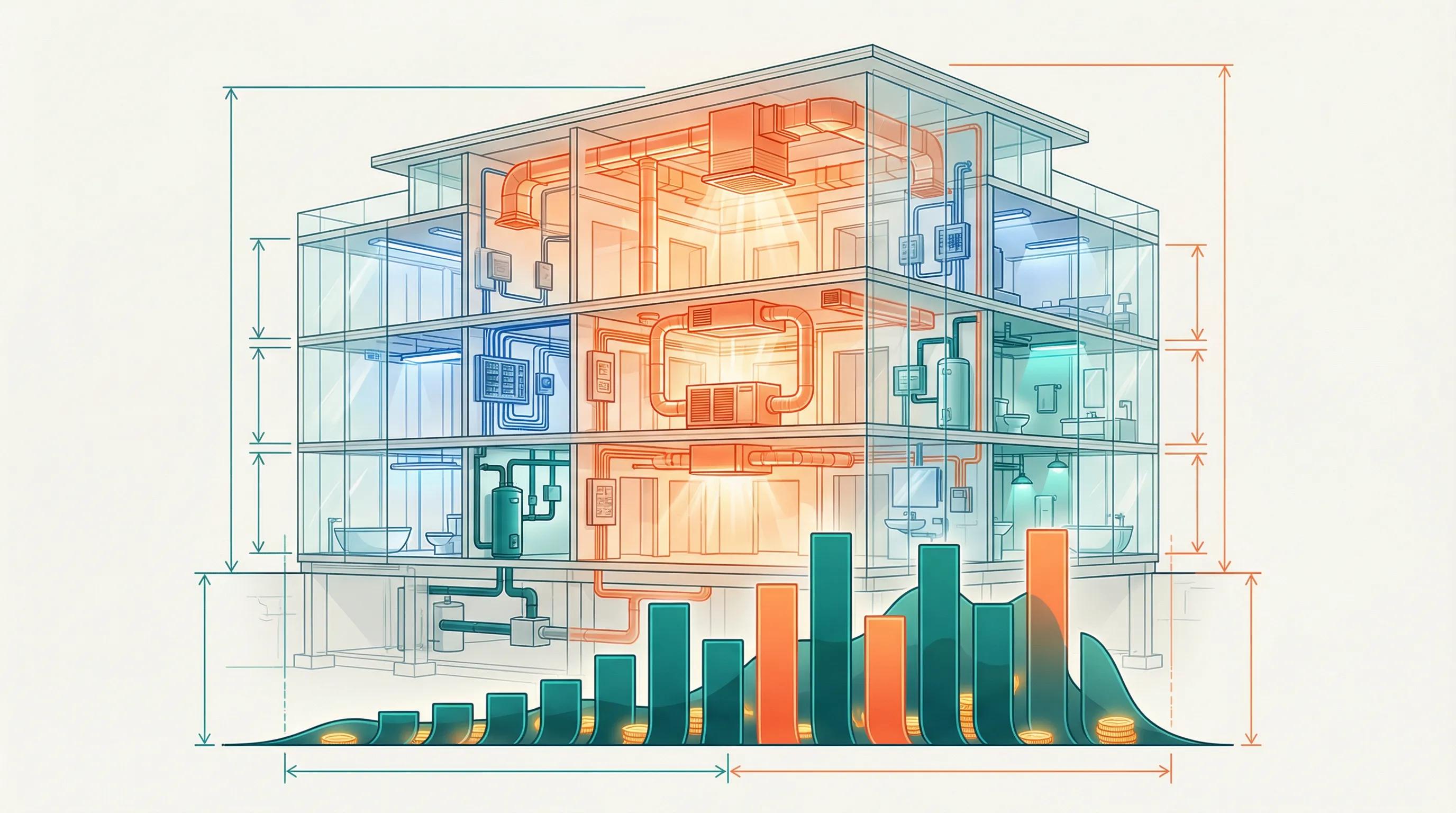
Institutional-Grade Savings Data—Now Free and Public
What you're about to see represents years of proprietary engineering analysis. This is data that cost segregation firms typically keep behind closed doors.
We built this database through 1,000+ real studies. These aren't theoretical estimates—these are actual results from properties across the United States. We're publishing this data because we believe in democratizing access to cost segregation—a strategy that's been reserved for institutional investors for too long.
Author's note (Overline): We've analyzed cost segregation outcomes across every major property type. The ranges below are drawn from our proprietary database of 1,000+ engineering-based studies. This is the same data we use internally to screen properties and estimate ROI.
How Cost Segregation Creates Savings
Cost segregation doesn't create "new" deductions—it accelerates them.
By identifying building components that depreciate in 5 or 15 years instead of the standard 27.5 or 39 years, investors reduce taxable income significantly in the early years of ownership.
Why this matters: A dollar saved on taxes today is worth more than a dollar saved five years from now. This is why sophisticated real estate investors treat cost segregation as standard practice on every acquisition above $500k—not an optional strategy.
With the 100% allowance reinstated for property acquired after January 19, 2025 by legislation enacted in July 2025, reclassified assets on that branch are fully deducted in year one.
Important: The total lifetime depreciation stays the same. You're shifting when you take it. Instead of waiting 27.5 years to fully depreciate a carpet, you depreciate it over 5 years (its actual useful life). The IRS Cost Segregation Audit Techniques Guide explicitly permits this when properly documented by qualified engineers.
Actual Acceleration Ranges by Property Type
These percentages represent how much of your building's depreciable basis can typically be reclassified from standard 27.5-year (residential) or 39-year (commercial) depreciation to accelerated 5-year and 15-year schedules.
Every number below comes from our proprietary database of 1,000+ completed engineering-based studies representing over $1 billion in analyzed real estate.
| Property Type | Purchase Price Range | Accelerated % | Primary 5-Year Components |
|---|---|---|---|
| Single-Family Rental | $300k – $2.5M+ | 24% – 34% | Cabinets, flooring, appliances, fencing |
| Duplex / Triplex / Fourplex | $400k – $3M+ | 24% – 32% | Unit improvements, parking, landscaping |
| Multifamily (6–20 units) | $1M – $15M+ | 28% – 38% | Common areas, clubhouse fixtures, pool |
| High-Rise Apartment (7+ stories) | $10M – $200M+ | 30% – 40% | Luxury finishes, gym, rooftop amenities |
| Office (Low-Rise) | $1.5M – $50M+ | 26% – 38% | Tenant fit-outs, carpet, data cabling |
| Office (Mid/High-Rise) | $10M – $300M+ | 26% – 38% | Specialized systems, lobby finishes |
| Restaurant (Quick Service) | $500k – $5M+ | 30% – 38% | Kitchen equipment, specialty plumbing |
| Restaurant (Full Service) | $1M – $15M+ | 32% – 44% | Bar fixtures, wine storage, millwork |
| Retail Strip Center | $2M – $50M+ | 30% – 38% | Storefronts, tenant improvements, signage |
| Hotel (Full Service) | $10M – $500M+ | 32% – 42% | FF&E, specialty lighting, pool systems |
| Warehouse / Industrial | $2M – $150M+ | 15% – 28% | Paving, loading docks, racking systems |
| Medical Office Building | $3M – $100M+ | 30% – 38% | Medical gas, specialized HVAC, casework |
"Accelerated %" = percentage of depreciable basis (purchase price minus land value) reclassified to 5-year and 15-year property combined. Lower end typically applies to older, simpler construction; upper end applies to newer properties with extensive amenities and specialty systems.
Why We're Publishing This Data
Most cost segregation firms guard these ranges like state secrets. They use information asymmetry to justify high fees and keep property owners in the dark about what's actually possible.
We're flipping that model. We built Overline on the belief that tax strategies shouldn't be reserved for billion-dollar funds. Paired with high-quality engineering partners, we deliver the same quality analysis to a $500k rental property owner as someone buying a $50M apartment complex.
This data alone—compiled from years of field work and engineering analysis—would cost millions to replicate. We're making it free because transparency drives better decisions.
Want to see what this means for your specific property? Run the free calculator.
Real Example: $1M Multifamily Property
| Metric | Value |
|---|---|
| Purchase Price | $1,000,000 |
| Land Value | $200,000 |
| Depreciable Basis | $800,000 |
Without Cost Segregation
Standard depreciation: $29,090 per year for 27.5 years. That's it.
With Cost Segregation (30% Reclassification)
| Asset Class | Amount | % of Basis |
|---|---|---|
| 5-year property | $176,000 | 22% |
| 15-year property | $64,000 | 8% |
| 27.5-year property | $560,000 | 70% |
With the 100% Allowance (Property Acquired After January 19, 2025)
- First-year deduction on reclassified assets: $240,000 (5-year + 15-year taken immediately)
- Plus standard depreciation on remaining basis: $20,364
- Total first-year depreciation: $260,364
At a 35% tax rate, that's $91,127 in first-year tax savings—compared to $10,181 without cost segregation.
The 100% bonus reinstatement makes this strategy 9x more powerful than standard depreciation.
For a quick preliminary estimate on your own property, Modern CFO's free calculator delivers instant, adjustable results.
Note: 100% bonus depreciation applies to property placed in service after January 19, 2025 per the One Big Beautiful Bill Act. Half-year convention and mid-quarter rules may apply. Use the calculator to model your specific scenario.
Who Gets the Most Benefit?
Based on our 1,000+ studies, these investor profiles consistently see the highest ROI:
High-Income W-2 Earners with Real Estate Professional Status
Doctors, tech employees, and executives who qualify as Real Estate Professionals (750+ annual hours in real property trades per IRC §469(c)(7)) can offset their W-2 income—not just rental income. This is the highest-value application in our database.
Short-Term Rental Operators
Properties with less than 7-day average guest stays often escape passive activity limitations entirely under IRS rules. Cost seg deductions become immediately usable against all income types—no REPS required.
Properties Above $500k Depreciable Basis
Tax savings consistently outweigh study costs at this threshold. Our data shows typical ROI of 15x–40x in year one, with some high-reclassification properties (restaurants, hotels) exceeding 50x.
Long-Term Holders (3–5+ Years)
Investors who hold long enough to compound the time-value benefit see the most dramatic wealth creation. Short hold periods (less than 18 months) reduce ROI due to depreciation recapture on sale.
Not sure if you fit the profile? Check whether cost segregation is worth it for your situation.
Frequently Asked Questions
Q: Does cost segregation work for properties I bought years ago? A: Yes. You can perform a "look-back" cost segregation study on properties purchased in prior years and claim catch-up depreciation in the current tax year using Form 3115 (change in accounting method). You don't need to amend prior returns—the IRS allows you to claim all "missed" depreciation in one year. Our database includes hundreds of look-back studies with identical savings to studies done at acquisition.
Q: What about depreciation recapture when I sell? A: Accelerated depreciation is recaptured at sale (taxed as ordinary income up to 25% recapture rate). However, the time value of having that cash earlier almost always outweighs the recapture cost, especially on hold periods of 3+ years. Additionally, 1031 exchanges can defer recapture indefinitely. Learn more about how to weigh this tradeoff in our decision framework.
Q: Are these savings guaranteed? A: The reclassification ranges above represent observed results from our database, not guarantees. Individual results vary based on construction quality, property age, specific features, and interior improvement levels. The free calculator gives you a property-specific estimate based on this data.
Q: How does the 100% allowance change the math? A: Substantially, for property acquired and placed in service after January 19, 2025. Under the phase-down, reclassified assets recovered only part of their basis in year one. On the 100% branch, all of the reclassified assets can be deducted in year one. For the $1M example above, that shifts $240,000 of depreciation into year one versus spreading it over 5 to 15 years. See our full breakdown of the One Big Beautiful Bill Act.
Q: What's the minimum property value where cost segregation makes sense? A: Generally, properties with $300k+ in depreciable basis (purchase price minus land) produce meaningful savings. Below that threshold, the study fee may reduce your net benefit. Use the calculator to check your specific ROI.
Ready to See Your Property's Numbers?
Get an instant estimate using our free calculator powered by our $1B+ database. If the ROI makes sense, we'll deliver an IRS-compliant study at 50% of what traditional firms charge—with full transparency and engineer review of every number.
See Your Property's Tax Savings
Drop your address. The AI estimates your depreciation savings in 60 seconds, backed by a certified engineer study.

Free cost segregation estimate, engineer-certified studies, and ongoing depreciation tracking.
Backed by $1B+ in supported tax depreciation.
Continue Reading
Explore more cost segregation guides from our library:
- Is Cost Segregation Worth It? — Decision framework to evaluate your property's ROI
- Cost Segregation for W-2 Earners Making $250K+ — The highest-ROI use case for cost seg
- Cost Segregation vs. Straight-Line Depreciation — Side-by-side comparison with real numbers
- Why Your CPA Didn't Tell You About Cost Segregation — The structural gap most investors miss
- Why Our Studies Cost 50% Less — Learn about our pricing and technology-driven approach
For deeper technical analysis on cost segregation strategies, see Modern CFO's savings benchmark data.
Disclaimer: Savings ranges are based on observed results from 1,000+ engineering-based cost segregation studies and represent typical outcomes, not guarantees. Individual results vary based on specific property conditions, construction methods, age, and other factors. This content does not constitute tax, legal, or financial advice. Consult qualified professionals regarding your specific situation.