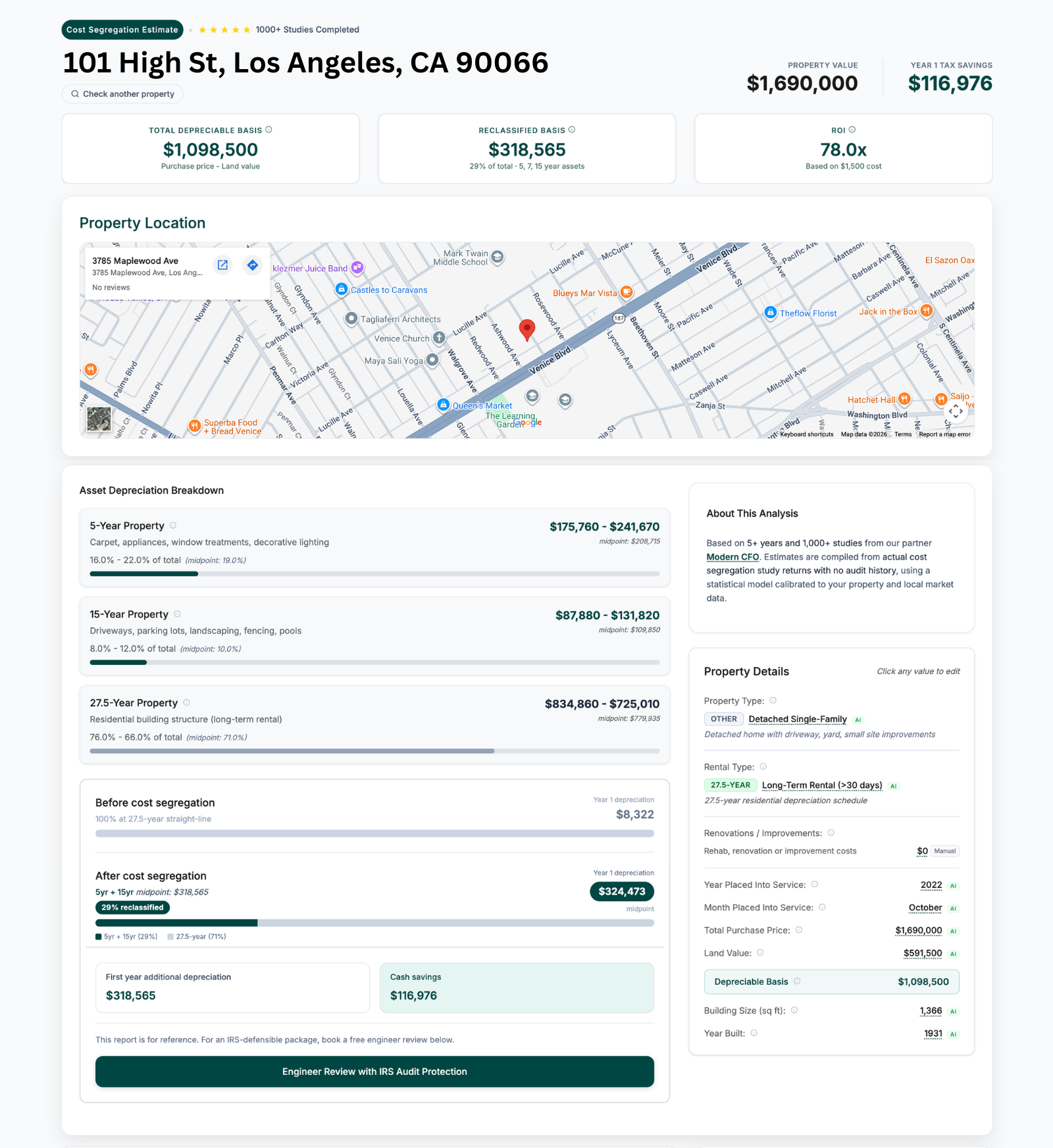
Accelerated Depreciation
Reclassify 20–30% of building value to 5–15 year schedules — front-loading deductions you're already entitled to.


Cost segregation is an IRS-approved method that accelerates depreciation, allowing real estate owners to reduce taxable income upfront and increase after-tax cash flow.
Trusted by real estate professionals at every stage.


















Reclassify 20–30% of building value to 5–15 year schedules — front-loading deductions you're already entitled to.
Qualifying components get bonus depreciation, unlocking significant additional write-offs in year one.
Most clients recover the study fee 5–30x in year-1 savings. PAD tracking captures more deductions every time you replace a component.
Based on a $1M rental property, 20% land value, a 37% marginal tax rate, and the 100% bonus depreciation branch, meaning property acquired and placed in service after January 19, 2025. Results vary.
Without cost segregation
$10,764
Year 1 tax savings
$96,335
Year 1 tax savings
Find out what your property qualifies for — free estimate in 60 seconds.
See My Property's SavingsBased on 1,000+ studies and $1B+ in accelerated depreciation. Most properties qualify.

Our cost segregation education is informed by James C. Peacock, former IRS General Engineer and contributor to the Cost Segregation Audit Techniques Guide. The point is not a prettier report. It is better support: land allocation, RS Means detail, site evidence, and audit-ready documentation.
2–4 weeks. We handle the rest.
Use our calculator above or schedule a call. Free estimate in 60 seconds.
Share closing docs and basic info. No appraisal needed.
Our certified engineer analyzes your property using satellite imagery, construction data, and IRS methodology.
Get your IRS-ready report. Share with your CPA and claim your accelerated depreciation.
ASCSP-certified engineers. IRS-approved methodology. Audit support included.
We coordinate with your CPA. Excel-ready schedules included.
No commitment. Free consultation.
Most firms hand you a report and disappear. We connect to your accounting and find tax savings every year.
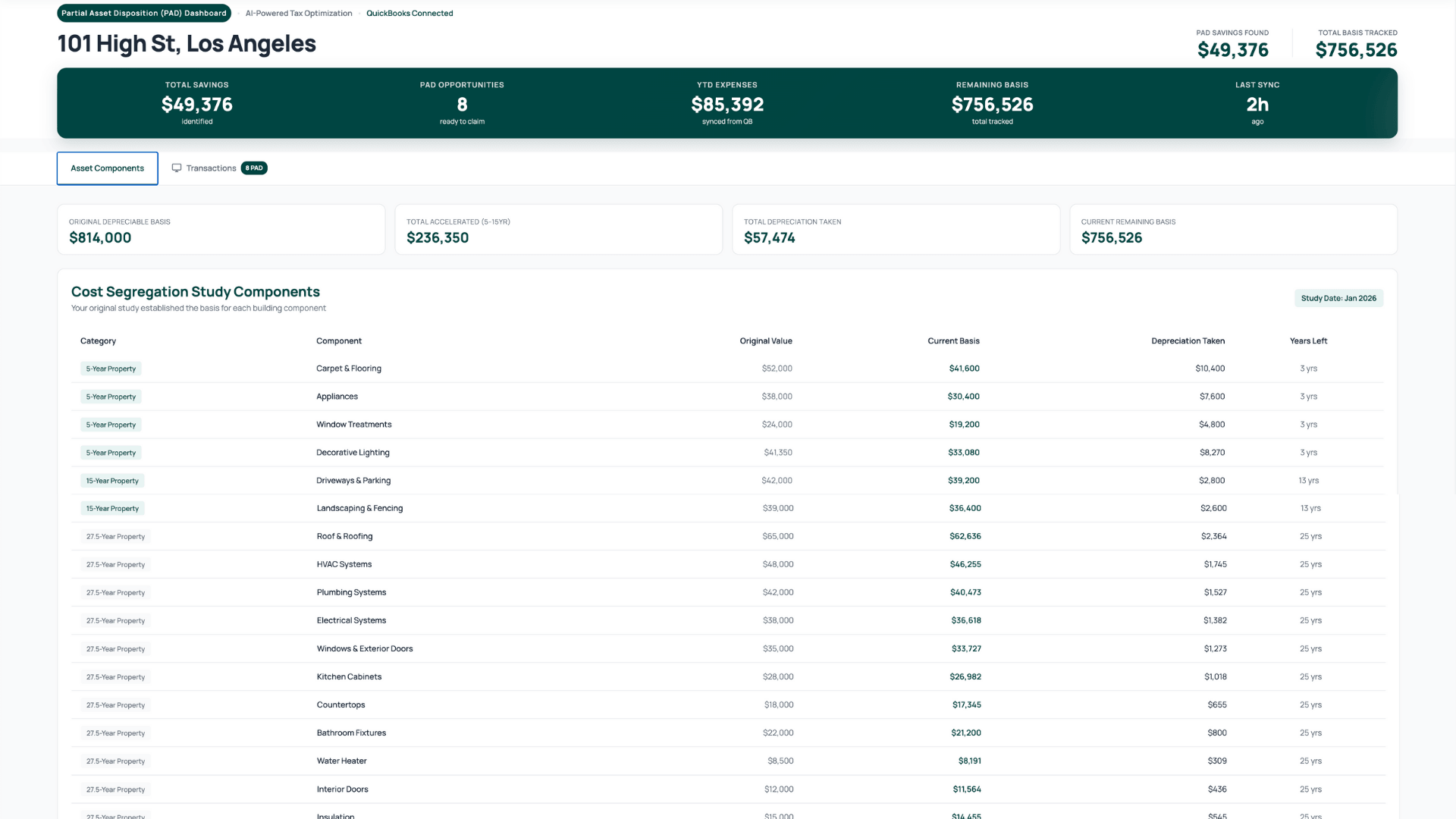
Your cost seg study identifies every component in your building—roof, HVAC, plumbing, flooring, and more—along with its value and depreciation schedule. We don't just hand you a PDF. We track each component's remaining basis so when you replace something, we know exactly how much you can write off.
✶Your cost seg study becomes a living document—not a forgotten PDF.
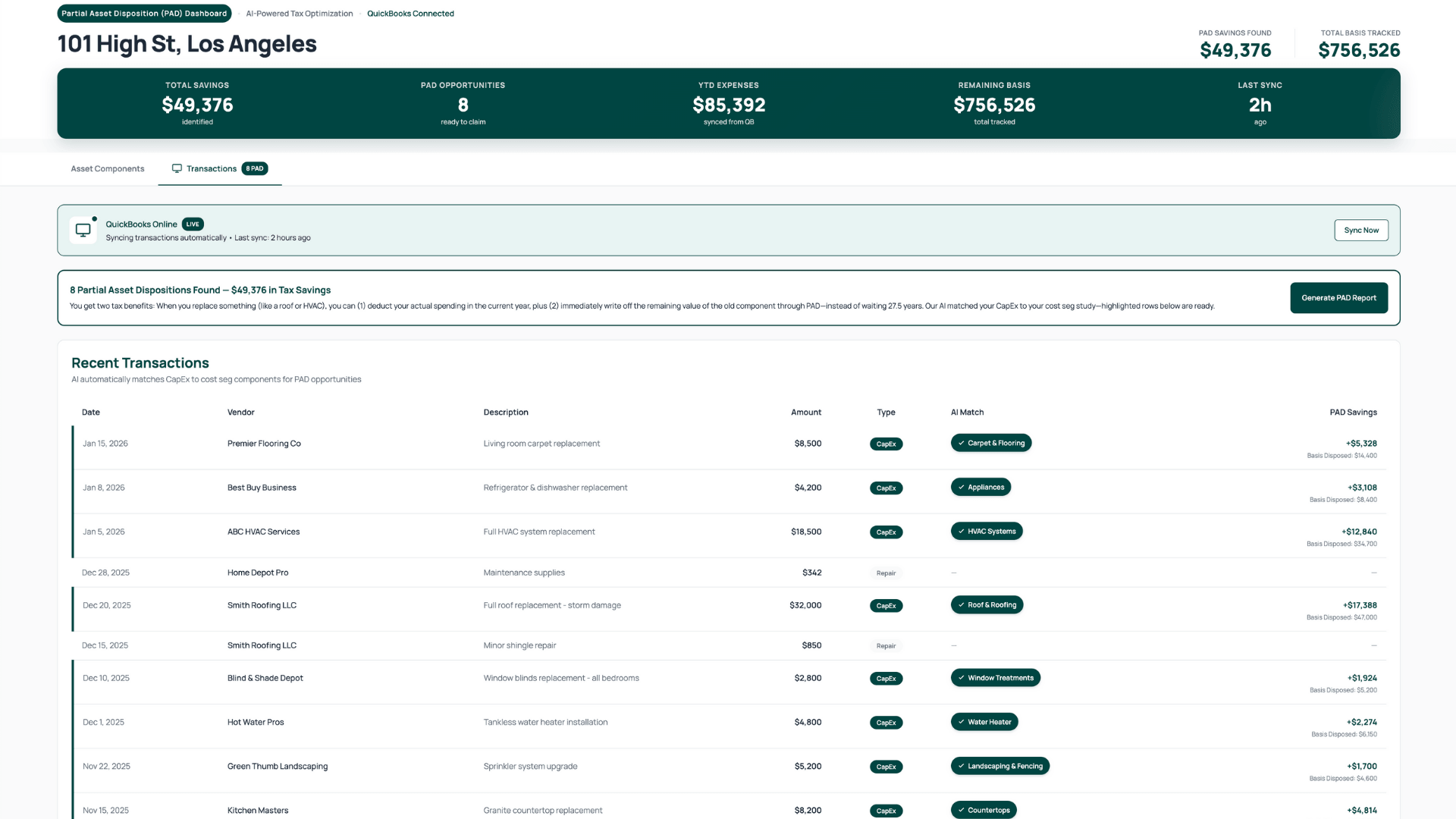
You get two tax benefits when you replace something: (1) deduct the cost of the new item, plus (2) write off the old component's remaining value immediately through PAD—instead of waiting 27.5 years.
✶Example: Replace a $50K HVAC → deduct $50K new unit + write off $32K old basis → save ~$30K in taxes.
Audit-ready studies. Lifetime support.
We identify all eligible tax benefits using construction data, satellite imagery, and 1,000+ study insights.
Certified engineers classify each component using IRS methodology and case law.
Verified estimates upfront. Know the impact before filing.
Lifetime audit support. Documentation and expert guidance included.
ASCSP engineers. 1,000+ studies. IRS-defensible results.
Talk to the engineer who signs off on your study.
 Engineer & CPA Partner
Principal Cost Segregation Engineer, Modern CFO
ASCSP Member: Industry standard for cost segregation engineering.

IRS examiner perspective: James C. Peacock spent 38.5 years at the IRS and contributed to the Cost Segregation Audit Techniques Guide. His guidance informs our audit-defensible education on documentation, support, and Section 179D.
Everything you need to know about cost segregation before getting started
Cost segregation is a tax strategy that accelerates depreciation by reclassifying portions of a building into shorter-life assets (5-, 7-, and 15-year property). Investors use it to pull deductions forward, often generating significant year-one tax savings while total lifetime depreciation remains the same. See actual savings by property type from our 1,000+ study database.
No, when done correctly. Cost segregation has been explicitly recognized by the IRS for decades. Audit risk typically comes from weak documentation or non-engineered reports, not from the strategy itself.
An IRS-defensible study is based on engineering analysis, asset-level classification, documented assumptions, and support tied to tax law and case precedent. This is the standard we follow for every study we deliver. Read our cost segregation legal guide for the court cases and frameworks that support these classifications.
No. We only provide fully engineered, IRS-ready cost segregation studies. We don't offer template, desktop-only, or non-engineered reports because they often introduce unnecessary risk for investors and CPAs.
Most income-producing properties placed in service after 1986 are eligible. This includes single-family rentals, short-term rentals (Airbnb/STR), multifamily properties, and many commercial buildings. The key requirement is that the property is used for business or investment purposes, not as a personal residence.
The fastest way is to use the free calculator at the top of this page. It gives you a quick estimate of potential depreciation and tax savings so you can decide whether a full engineered study makes sense. For a deeper analysis, read our decision framework based on 1,000+ studies.
The calculator estimates how much of your property could be reclassified into shorter-life assets, how depreciation is accelerated, and the potential tax impact based on your assumptions. It's designed for planning and decision-making. Learn more about how the calculator works and the AI methodology behind it.
The calculator is directional — typically within 10–20% of final study results for standard properties. A full engineered study is more precise because it's based on actual purchase documents, renovation costs, and detailed engineering analysis. Most investors use the calculator first, then confirm with a study. See our full accuracy breakdown.
Yes. You can adjust inputs like land value, tax rate, placed-in-service year, and reclassification assumptions to instantly see how outcomes change. This is useful for tax planning and timing decisions.
Yes. The calculator is free and available instantly. It's meant to help you evaluate whether cost segregation is worth pursuing before committing to a study.
If your property has major renovations, prior depreciation, ownership changes, or you're planning around a specific tax year or deadline, it's usually worth chatting with us. A short conversation can clarify edge cases the calculator can't fully capture.
For purchases, we typically need the settlement statement, purchase agreement, and basic property details. For renovation projects, we review improvement invoices, contractor scopes, and placed-in-service dates. We'll clearly outline exactly what's needed after a short intake.
Most engineered studies are completed in 2–4 weeks after we receive the required documentation. If you're working against a tax deadline, we recommend reaching out early to confirm timing.
Our cost segregation studies start at $1,000 for a simple single-family rental and increase based on property size, complexity, and scope of analysis — roughly 50% less than traditional firms. We provide a fixed-fee quote upfront so you can clearly evaluate return on investment before moving forward.
Yes. Our studies are built to be CPA-ready with clear schedules, classifications, and supporting documentation. We're also happy to coordinate directly with your CPA to make filing straightforward.
If the IRS reviews your return, we provide documentation and technical support to help your CPA respond. Our methodology and reporting are designed with audit review in mind.
The IRS requires depreciation to be calculated using your actual cost basis, not current market or appraised value. Depreciation is meant to recover your investment in the property, not unrealized appreciation, which keeps deductions objective and verifiable.
If you're early in the process, start by running the free calculator above. If you want to learn more first, explore our guides: Is cost segregation worth it?, How much does it save?, and Why our studies cost 50% less. If the numbers look meaningful or your situation is more complex, chat with us and we'll help you decide the best next step.
Your study will be personally signed off by Matthew Gigantelli, Principal Cost Segregation Engineer at Modern CFO — our trusted engineering and CPA partner. Matthew's credentials include: 5+ years specialized in cost segregation engineering, $1Bn+ in accelerated depreciation delivered, 1,000+ studies completed across all property types, methodology aligned with IRS Audit Techniques Guide, and ASCSP certification (Member #M009-25). Book a call with Matthew directly →
Cost segregation isn't right for everyone. It may be a poor fit if: (1) You can't use the deductions — W-2 earners without Real Estate Professional Status or the short-term rental loophole face passive activity limitations that suspend cost seg losses, meaning you can't offset your salary. (2) You're selling within 18 months — depreciation recapture taxes at ordinary rates (up to 37% for Section 1245 property) can erase most of the benefit on short holds. (3) Your depreciable basis is under $200K and study fees are high — the net savings may be thin. (4) You're in a low tax bracket (12–15%) — deductions are worth less at lower rates. (5) The provider isn't qualified — non-engineered or template-based studies create audit risk without defensible results. We believe in honest assessments — if cost segregation doesn't make sense for your property, we'll tell you. Read our full guide: Why cost segregation is a bad idea (sometimes).
When you sell a property, the IRS 'recaptures' accelerated depreciation and taxes it. Unrecaptured Section 1250 gain on buildings is taxed at a maximum rate of 25%. Section 1245 property, the personal property that cost segregation reclassifies such as fixtures, flooring and appliances, is recaptured as ordinary income, so the rate is your ordinary rate up to the top bracket of 37%. Neither is a flat rate that applies to every seller: both are ceilings, and your own rate depends on your bracket and the character of the gain. Whether the timing benefit outweighs recapture on a given hold, and how a 1031 exchange changes that, is a modelling question for your CPA. See our guide on why tax strategies fail at exit.
Only if you meet specific IRS requirements. Standard rental income is classified as 'passive' under IRC §469, which means losses can't offset W-2 income. Two exceptions unlock this: (1) Real Estate Professional Status (REPS) — requires 750+ hours/year in real estate AND more than 50% of your total working time, which is difficult with a full-time job. (2) Short-term rental loophole — if your rental has an average guest stay under 7 days and you materially participate (100+ hours/year), it's not classified as a 'rental activity' and losses can offset any income. Without either exception, cost segregation deductions are suspended until you generate passive income or sell the property. This doesn't mean they're lost — just delayed. Read our full guide: Cost segregation for W-2 earners.