

About the Author
This guide was written by Matthew Gigantelli, a cost segregation engineer who has personally toured and completed engineered studies on over 3,000 properties — from single-family rentals to heavy manufacturing facilities and commercial buildings valued at over $100 million. Gigantelli holds a B.A. in Finance (summa cum laude) from Rasmussen University and a certification from Boon Tax Educators (2026). He has spent the past four-plus years engineering cost segregation studies across every major property type in the United States.
Matthew Gigantelli on why he wrote this guide: "I get asked constantly whether investors can do cost segregation themselves. The honest answer is: you can try, and this guide shows you exactly how. But once you see what the process actually involves — 8 steps, hundreds of components, RS Means pricing, legal classification under case law — most people realize why they hire an engineer."
What a Cost Segregation Study Actually Does
A cost segregation study does not create new deductions. It reclassifies existing building costs into shorter recovery periods under the Modified Accelerated Cost Recovery System (MACRS), accelerating depreciation that would otherwise be spread over 27.5 years (residential) or 39 years (commercial).
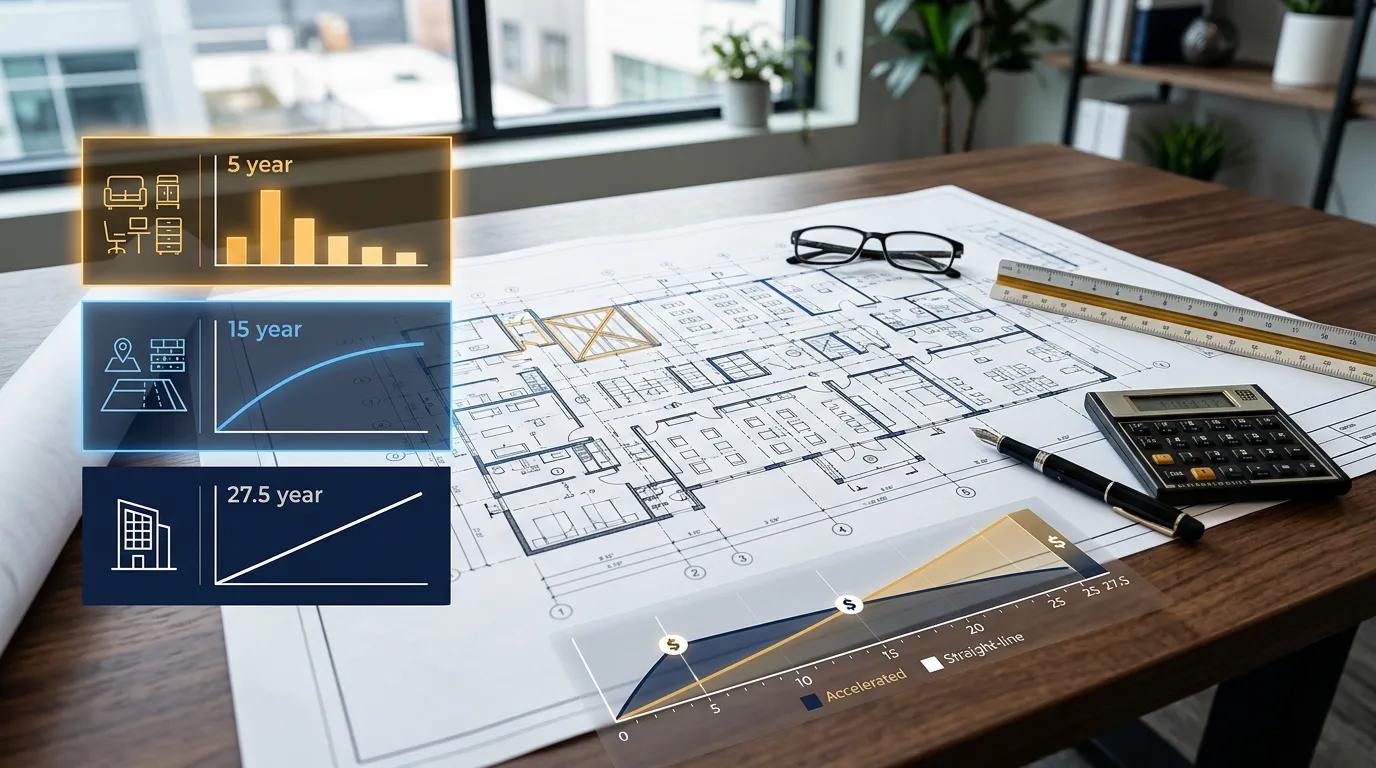
Every building contains components that the IRS allows you to depreciate faster than the building itself:
- 5-year property (tangible personal property): flooring, cabinetry, appliances, decorative lighting, specialty electrical
- 15-year property (land improvements): parking lots, landscaping, fencing, sidewalks, exterior lighting, drainage systems
- 27.5-year or 39-year property (the building structure): foundation, framing, roof, HVAC, general electrical, plumbing
Without a cost segregation study, the entire building (minus land) is depreciated at the longest recovery period. With a study, 20%–30% of the depreciable basis is typically reclassified to 5-year and 15-year property. Under bonus depreciation rules, those reclassified amounts can be deducted in full in Year 1.
According to Matthew Gigantelli: "Most online explanations of cost segregation stop here — 'reclassify assets, save taxes.' That is the what. This guide covers the how — the 8-step engineering process that determines which components qualify, what they cost, and how to defend those classifications if the IRS asks."
The 8-Step Engineering Process
This is the process a qualified cost segregation engineer follows for every study. Each step builds on the previous one. Skipping any step weakens the entire study.
Step 1: Scope and Pre-Qualification
Before any work begins, the engineer determines whether the property is a good candidate and defines the study parameters.
Information gathered at this stage:
- Property type (residential rental, commercial, mixed-use, specialty)
- Acquisition date or placed-in-service date
- Purchase price or construction cost
- Study type: acquisition study (purchased property), construction study (newly built), or look-back study (property owned for years, filed via IRS Form 3115)
- Current depreciation method and any prior cost segregation work
Not every property justifies a study. As a general rule, properties with a depreciable basis under $150,000–$200,000 may not generate enough accelerated depreciation to justify the cost of a professional study — though technology-enabled approaches have lowered that threshold significantly.
Matthew Gigantelli: "I turn down studies when the math does not work. If someone has a $120,000 condo with no site improvements, the accelerated allocation might be $15,000–$20,000. At a 37% tax rate, that is $5,500–$7,400 in savings. It can still make sense with a low-cost, technology-enabled study, but it would not justify a $5,000+ traditional engagement."
Step 2: Document Gathering
The engineer collects every available document related to the property's construction and acquisition. More documentation means more accurate cost allocation.
| Document | Purpose | Required? |
|---|---|---|
| Purchase price allocation or closing statement (HUD-1/CD) | Establishes total depreciable basis and land allocation | Yes |
| Architectural drawings and site plans | Identifies building layout, dimensions, and site improvements | If available |
| Construction invoices or pay applications | Provides actual component costs for new construction | If available |
| Current depreciation schedule (Form 4562) | Shows existing tax treatment for look-back studies | For look-back |
| Property survey or plat map | Confirms site dimensions, easements, and improvements | If available |
| Rent roll or lease abstracts | Determines residential vs. nonresidential classification | If applicable |
| Appraisal report | Provides independent value allocation and property condition data | If available |
For acquisition studies (the most common type), the closing statement and any available plans are usually sufficient. The engineer supplements missing documentation with field measurements and RS Means cost estimation.
Step 3: Site Visit and Physical Inspection
The site visit is where the engineer physically inspects and documents every component of the property. This is the step that separates an engineering-based study from a desktop estimate.
What the engineer inspects and photographs:
- Every room (flooring type, wall finishes, ceiling treatments, cabinetry, fixtures)
- Kitchen and bathrooms (countertops, appliances, specialty plumbing, exhaust systems)
- Mechanical systems (HVAC units, ductwork, water heaters, specialty ventilation)
- Electrical systems (panel boxes, dedicated circuits, decorative lighting, data cabling)
- Building exterior (roofing, siding, windows, awnings, signage)
- Site improvements (parking areas, sidewalks, curbing, fencing, retaining walls, landscaping, irrigation, exterior lighting, drainage)
- Specialty components (pools, elevators, fire suppression, security systems)
A typical residential cost segregation study produces 80–150 photographs. A typical commercial study produces 200–500+ photographs. Each photograph is tagged with the component description, location, and eventual MACRS classification.
Matthew Gigantelli: "The photographs are the study's evidence. If an IRS examiner asks 'how did you classify this component?' the answer is a photograph with a cost estimate attached to it. A spreadsheet without photographs is an opinion. A spreadsheet with photographs is documentation."
Step 4: Component Identification Using CSI MasterFormat
After the site visit, the engineer catalogs every identified component using the Construction Specifications Institute (CSI) MasterFormat — the industry-standard classification system used across construction, architecture, and engineering.
CSI MasterFormat organizes building components into numbered divisions. Each division maps to typical MACRS recovery periods, though the mapping is not always one-to-one:
| CSI Division | Description | Common Components | Typical MACRS Life |
|---|---|---|---|
| 02000 | Site Construction | Paving, grading, drainage, utilities | 15-year |
| 03000 | Concrete | Sidewalks, curbing (site-related) | 15-year |
| 05000 | Metals | Structural steel, railings, stairs | 39-year (usually) |
| 07000 | Thermal and Moisture Protection | Awnings (5-yr), roofing (39-yr) | Split |
| 08000 | Doors and Windows | Exterior doors, storefronts | 39-year (usually) |
| 09000 | Finishes | Flooring, wall coverings, cove base, paint | 5-year |
| 10000 | Specialties | Signage, fire extinguishers, toilet accessories | 5-year |
| 11000 | Equipment | Kitchen equipment, laundry, appliances | 5 or 7-year |
| 12000 | Furnishings | Cabinetry, countertops, window treatments, shelving | 5-year |
| 15000 | Mechanical | HVAC (39-yr), specialty venting and exhaust (5-yr) | Split |
| 16000 | Electrical | General wiring (39-yr), dedicated circuits and decorative lighting (5-yr) | Split |
Matthew Gigantelli: "The CSI code tells you what the component is. The MACRS classification tells you how long you depreciate it. They are not the same thing — and confusing them is one of the most common DIY mistakes. A concrete sidewalk (CSI 03000) is 15-year property. A concrete foundation (also CSI 03000) is 39-year property. The CSI code is the same. The tax treatment is completely different."
Step 5: Quantity Take-Offs
"Take-off" is the construction industry term for measuring every component — counting units, measuring areas, calculating linear footage. This is the most labor-intensive step of the study.
The engineer measures each identified component using a combination of field measurements (from the site visit), architectural drawings (if available), and aerial/satellite imagery (for site dimensions).
Example quantity take-offs from a real study:
| Component | Quantity | Unit | How Measured |
|---|---|---|---|
| Asphalt paving | 6,560 | SY | Site plan + field verification |
| Carpet flooring | 3,970 | SF | Room-by-room measurement |
| Duplex electrical outlets | 521 | Ea | Physical count |
| Exterior light fixtures | 146 | Ea | Physical count |
| Concrete sidewalks | 1,695 | SY | Site plan + field verification |
| Concrete curbing | 2,720 | LF | Site plan + field verification |
| Window awnings | 2,300 | SF | Field measurement |
| Retaining wall | 1,590 | SF | Field measurement |
| Kitchen base cabinets | 12 | Ea | Physical count |
| Landscape trees | 45 | Ea | Physical count |
Every quantity feeds directly into the cost calculation in Step 6. An error here — miscounting outlets, undermeasuring paving — flows through to the final allocation.
Step 6: Cost Estimation Using RS Means
This is the technical core of a cost segregation study. The engineer assigns a cost to every component using RS Means, the construction industry's standard cost database.
What is RS Means?
RS Means (published by Gordian) contains over 92,000 unit cost line items updated annually, covering material, labor, and equipment costs across 970+ U.S. locations. It is the most widely used construction cost reference in the United States and is recognized by the IRS as an acceptable cost source for cost segregation studies.
Each RS Means line item includes:
- Bare Material cost — the material itself
- Bare Labor cost — installation labor at union rates
- Bare Equipment cost — equipment rental for installation (if applicable)
- Bare Total — sum of material, labor, and equipment
- Total Including Overhead and Profit (O&P) — the installed cost including contractor markup
How the engineer calculates component cost:
The extended cost for each component is calculated as:
Extended Cost = Quantity x Unit Price (Total incl. O&P) x Location Factor
The location factor adjusts national RS Means costs to local market conditions. RS Means publishes location factors for 970+ U.S. cities and zip codes. A location factor of 0.844 means local construction costs are 84.4% of the national average. A factor of 1.15 means local costs are 15% above national average.
Example: 521 duplex receptacles at $50.00 per unit (RS Means Total incl. O&P for a 20-amp grounded duplex) with a location factor of 0.844 = $21,986 in allocated cost.
For the full RS Means pricing table with material, labor, and equipment breakdowns for common cost segregation components, see our Sample Cost Segregation Report walkthrough.
Step 7: MACRS Classification — The Legal Framework
After every component has been identified, measured, and priced, the engineer classifies each one into the correct MACRS recovery period. This is the step that requires professional judgment and knowledge of tax law and case precedent.
The legal framework for classification:
- IRC §168(e) — defines recovery periods for tangible property
- IRC §1245(a)(3) — defines personal property (eligible for 5-year or 7-year recovery)
- IRC §1250(c) — defines real property (27.5-year or 39-year recovery)
- Rev. Proc. 87-56 — provides asset class lives (00.3 for land improvements at 15 years, 57.0 for distributive trades)
The Whiteco Six-Factor Permanency Test:
The landmark Whiteco Industries v. Commissioner case established six factors for determining whether a building component is personal property (shorter life) or structural (longer life):
- Is the component permanently affixed to the building? (Can it be removed without damage?)
- Is it designed to remain in place indefinitely? (Or is it expected to be replaced?)
- Are there circumstances that would require its removal? (Tenant turnover, wear patterns?)
- Can it be removed quickly and with minimal expense? (Carpet vs. foundation?)
- Is it readily movable? (Appliances vs. load-bearing walls?)
- Does the component damage the building or lose value upon removal?
The more factors that favor "not permanent," the stronger the case for personal property classification (5-year or 7-year).
The Functional Use Test:
Some components serve dual purposes. Electrical wiring that powers the building's HVAC system is structural (39-year). Electrical wiring dedicated to a specific piece of equipment (a commercial oven, a security system) is personal property (5-year). The engineer must evaluate each component's primary function.
Matthew Gigantelli: "The legal classification is where most DIY attempts fail. You can measure carpet and look up the price — that is straightforward. But deciding whether a retaining wall is a 15-year land improvement or a 39-year structural component requires applying the Whiteco permanency factors to the specific construction — and that is a judgment call backed by case law, not a lookup table."
Step 8: Report Assembly and Indirect Cost Allocation
The final step combines all previous work into a deliverable report and applies indirect cost allocation — a step most DIY attempts skip entirely.
Indirect costs are construction costs that do not attach to a single component but benefit the entire project. They include:
| Indirect Cost Category | Typical Rate | Applied To |
|---|---|---|
| Architectural and design fees | 4%–6% of building cost | All building components |
| Construction management | 3%–5% of building cost | All building components |
| Electrical engineering | 3%–5% of contract cost | Electrical components |
| Mechanical engineering | 3%–5% of contract cost | Mechanical components |
| Site engineering and landscape architecture | 2%–3% of contract cost | Site improvements |
| Permits, insurance, and bonding | 1%–3% of contract cost | All components |
How indirect costs are allocated:
Each component receives a proportional share of indirect costs based on its share of total direct costs. If a component represents 5% of total direct construction cost, it receives 5% of the applicable indirect costs.
This matters because indirect cost allocation increases the value of every accelerated component. Skipping this step — as most DIY and desktop studies do — undervalues 5-year and 15-year property by an estimated 8%–15% of their true allocated cost.
The final report typically contains 30–80+ pages and includes: cover letter with engineer certification, executive summary, property description, methodology, asset register with every line item, facilities summary by CSI division, photograph appendix, and professional qualifications.
For a complete walkthrough of what each section contains, see our Sample Cost Segregation Report.
The DIY Approach: What You Can Actually Do Yourself
Before attempting a DIY study, start by running your property through Modern CFO's free cost segregation calculator to see what a professional analysis might yield. This gives you a baseline to compare your own work against.
Now that you understand the full engineering process, here is what you can realistically accomplish on your own for a residential rental property.
Room-by-Room Walkthrough
Go through your property systematically and document every component that might qualify for accelerated depreciation:
Kitchen:
- Cabinets (base and wall) — count each unit
- Countertops — measure linear feet or square feet
- Appliances (range, refrigerator, dishwasher, microwave) — count and note brand/model
- Specialty lighting (under-cabinet, pendant) — count fixtures
- Exhaust hood or ventilation — note type
Bathrooms:
- Vanity cabinets — count each
- Countertops — measure
- Specialty fixtures (decorative faucets, vessel sinks) — count
- Mirrors (if decorative/removable) — count
- Exhaust fans — count
Living Areas and Bedrooms:
- Flooring type and area (carpet, vinyl plank, hardwood — measure square feet per room)
- Window treatments (blinds, shutters) — count per window
- Ceiling fans — count
- Built-in shelving or millwork — measure
Exterior and Site:
- Paved areas (driveway, parking, walkways) — estimate square footage
- Fencing — measure linear feet, note type and height
- Landscaping (trees, shrubs, sod, irrigation) — count major plantings
- Exterior lighting — count fixtures
- Retaining walls — measure square feet of face area
- Drainage systems — note if visible
Pricing Your Components
Without an RS Means subscription ($1,000+/year), you can estimate component costs using:
- Home Depot / Lowe's online pricing — search for the specific product and use the installed price if available
- Contractor estimates — get quotes for replacing each component (the replacement cost is what you need)
- Gordian's free square-foot estimator — provides rough building cost by type and location
- Your own construction invoices — if you built or renovated, your actual costs are the best source
The Classification Decision Tree
For each component, ask these questions in order:
- Is it attached to the land but not the building? (Paving, fencing, landscaping, exterior lighting, drainage) → 15-year land improvement
- Can it be removed without damaging the building structure? (Carpet, cabinets, appliances, window treatments, decorative lighting) → 5-year personal property
- Is it a piece of equipment with a specific function? (Appliances, commercial kitchen equipment, security systems) → 5-year or 7-year personal property
- Is it part of the building's basic structure or systems? (Foundation, framing, roof, general HVAC, general electrical, general plumbing) → 27.5-year or 39-year real property
Note that this classification decision tree only covers cost segregation. The IRS also distinguishes between repairs (currently deductible) and improvements (capitalized and depreciated) — a separate but equally important determination. For the full framework on that distinction, see our guide on repairs vs. improvements for rental property taxes.
Calculating Your Overhead Allocation
If you know the total construction cost and can estimate indirect costs (typically 10%–15% of total for residential), apply them proportionally:
Component Indirect Cost = (Component Direct Cost / Total Direct Cost) x Total Indirect Costs
Where DIY Breaks Down: 7 Things You Will Get Wrong
After reviewing hundreds of self-prepared and desktop cost segregation studies, these are the seven most common failure points:
1. Dual-Function Components
Electrical wiring is the classic example. General building wiring is 39-year property. But wiring dedicated to a specific appliance, a security system, or decorative lighting is 5-year property. The "functional use test" requires evaluating each circuit's primary purpose — not just counting outlets.
2. Indirect Cost Allocation
Most DIY studies skip indirect costs entirely. This means every accelerated component is undervalued by 8%–15%. On a $500,000 property with $100,000 in accelerated components, that is $8,000–$15,000 in missed basis — and $3,000–$5,500 in missed tax savings.
3. Location Factor Adjustment
RS Means publishes national average costs. Construction costs in San Francisco are 30%+ above the national average. Construction costs in rural Texas are 15%+ below. Using unadjusted national prices — or worse, Home Depot retail prices — produces inaccurate cost allocations that may not withstand IRS scrutiny.
4. The Permanency Test Judgment Calls
Is a built-in bookshelf personal property or a structural component? It depends on how it is attached, whether it can be removed without damage, and whether it was designed to be permanent. The Whiteco six-factor test requires professional interpretation of case law — not a yes/no checklist.
5. Missing Components You Cannot See
Underground utilities, embedded electrical conduit, subsurface drainage systems, and below-grade waterproofing are all potentially classifiable as 15-year land improvements or 5-year personal property. If you did not build the property, you likely do not know what is underground. An engineer uses construction standards and RS Means to estimate these hidden components.
6. No Engineer Sign-Off
The IRS Audit Techniques Guide (ATG) for cost segregation specifically evaluates the "qualifications of the preparer." A study prepared by a qualified engineer or construction professional carries significantly more weight than a self-prepared spreadsheet. This does not mean the IRS will reject a DIY study outright — but it does mean the burden of proof shifts entirely to you. A self-prepared study is one of several rental property IRS audit red flags that can increase your chances of examination.
7. No Photography Documentation
The photograph appendix — 80 to 500+ tagged photos — is what survives an IRS examination. It provides visual evidence that each classified component actually exists, is in the condition described, and matches the cost estimate. A spreadsheet without photographs is an assertion. A spreadsheet with photographs is documentation.
Matthew Gigantelli: "I have reviewed hundreds of DIY and desktop studies. The most common pattern is the same: they capture the obvious components — carpet, cabinets, appliances — and miss everything else. The result is a study that reclassifies 8%–12% of basis when the engineering-based number should be 20%–28%. That is tens of thousands of dollars in missed deductions on a typical rental property."
The Cost-Benefit Decision
| Approach | Typical Cost | Typical Allocation | IRS Defensibility | Best For |
|---|---|---|---|---|
| DIY (self-prepared) | $0 + your time | 8%–12% (common undercapture) | Low — no professional sign-off | Screening, education, very low-value properties |
| Desktop study (template-based) | $500–$2,000 | 15%–20% | Moderate — no site visit | Quick estimates, properties under $300K |
| Engineering-based (technology-enabled) | Fraction of traditional cost | 20%–28% (full capture) | High — engineer-reviewed, site visit | Residential, small-to-mid commercial |
| Engineering-based (traditional firm) | $5,000–$15,000+ | 20%–28% (full capture) | High — PE sign-off, on-site inspection | Large commercial, complex properties |
ROI Comparison at Common Property Values
Assumes 20% land allocation, 37% marginal tax rate, 100% bonus depreciation for property acquired and placed in service after January 19, 2025, and residential baseline allocation of 24% (from 8,000+ study benchmarks):
| Property Value | Depreciable Basis | DIY Result (12%) | Engineering Result (24%) | Difference in Year 1 Tax Savings |
|---|---|---|---|---|
| $400,000 | $320,000 | $14,200 | $28,400 | $14,200 |
| $750,000 | $600,000 | $26,600 | $53,300 | $26,700 |
| $1,000,000 | $800,000 | $35,500 | $71,000 | $35,500 |
| $2,000,000 | $1,600,000 | $71,000 | $142,100 | $71,100 |
The difference between a DIY study capturing 12% and an engineering-based study capturing 24% is approximately equal to the DIY savings itself — meaning a professional study typically doubles your first-year tax benefit.
Frequently Asked Questions
Q: Can I do my own cost segregation study?
A: Yes, there is no legal requirement that a cost segregation study be prepared by a licensed professional. However, the IRS Audit Techniques Guide specifically evaluates the "qualifications of the preparer" when reviewing cost segregation studies. A self-prepared study carries a higher burden of proof in an examination. Based on industry data, DIY studies typically capture only 8%–12% of depreciable basis in accelerated categories, compared to 20%–28% for engineering-based studies — a gap that represents tens of thousands of dollars in missed deductions on most properties.
Q: What does a cost segregation engineer actually do?
A: A cost segregation engineer follows an 8-step process: (1) scope and pre-qualify the property, (2) gather construction and acquisition documents, (3) conduct a physical site visit with detailed photography, (4) identify every building component using CSI MasterFormat codes, (5) perform quantity take-offs (measuring each component), (6) estimate replacement costs using RS Means construction cost data, (7) classify each component into the correct MACRS recovery period using the Whiteco permanency test and functional use test, and (8) assemble the final report with indirect cost allocation. A typical residential study involves 80–150 photographs and 50–200+ individual component line items.
Q: Will the IRS accept a DIY cost segregation study?
A: The IRS does not require a specific credential for cost segregation preparers. However, the IRS Audit Techniques Guide evaluates studies based on methodology, documentation quality, and preparer qualifications. Studies prepared using the engineering-based cost approach with RS Means pricing, site visit photography, and qualified professional oversight are significantly more defensible than self-prepared studies. The IRS has never published a ruling rejecting a study solely because it lacked professional preparation — but the practical reality is that a study without engineering support, photography, and proper methodology is far more likely to be adjusted or disallowed during examination.
Q: How long does a professional cost segregation study take?
A: Timeline varies by property complexity and study type. A typical residential rental property (single-family or small multifamily) takes 1–3 weeks from engagement to final report with an AI-native engineering provider, or 6–12 weeks with a traditional firm. Large commercial properties can take 6–12 weeks. The site visit itself takes 1–4 hours for residential and 1–3 days for large commercial properties. For a full breakdown of what studies cost and how pricing varies by provider type, see our cost segregation pricing benchmarks from 3,000+ engagements.
Q: What is the difference between a desktop study and an engineering-based study?
A: A desktop study estimates asset allocation using templates, square-foot cost models, and property type averages — without a physical site visit. An engineering-based study includes a physical inspection, component-level photography, individual quantity take-offs, RS Means unit pricing for each component, and MACRS classification based on the Whiteco permanency test. Desktop studies typically allocate 15%–20% of basis to accelerated categories. Engineering-based studies typically allocate 20%–28%. The IRS Audit Techniques Guide specifically notes that studies without site visits lack the documentation needed to support component-level classifications.
Q: Is cost segregation worth it for a rental property under $500,000?
A: For most rental properties valued at $300,000 or above, cost segregation produces meaningful tax savings. On a $400,000 residential property (assuming 20% land, 24% accelerated allocation, 37% tax rate), first-year bonus depreciation savings are approximately $28,400. Even at $250,000, savings of approximately $17,800 can justify a technology-enabled study that costs a fraction of traditional firm pricing. Properties under $200,000 with minimal site improvements may not generate sufficient savings to justify any study. See our Cost Segregation Benchmarks from 8,000+ Studies for detailed savings calculations by property value.
Partner Resources from Modern CFO
- Can You Do Cost Segregation Yourself? — An engineer's honest assessment
- Free Calculator vs Full Engineering Study — When each makes sense
- Inside a Cost Segregation Report — What a real report looks like
- Cost Segregation Site Inspection — What engineers look for on-site
See Your Property's Tax Savings
Drop your address. The AI estimates your depreciation savings in 60 seconds, backed by a certified engineer study.

Free cost segregation estimate, engineer-certified studies, and ongoing depreciation tracking.
Backed by $1B+ in supported tax depreciation.