

About the Author
This guide was written by Matthew Gigantelli, a cost segregation engineer and real estate tax strategist at Overline who has completed engineered studies on over 3,000 properties, including hundreds of new-construction and conversion projects. Gigantelli holds a B.A. in Finance (summa cum laude) from Rasmussen University and a certification from Boon Tax Educators (2026).
Matthew Gigantelli on ADU cost segregation: "ADUs are the most cost-seg-friendly property type I encounter. The construction records are clean, the component mix is heavily weighted toward short-lived assets, and the land allocation is minimal because the land already exists. A $200K detached ADU routinely produces $50K-$70K in first-year deductions — and the study takes half the time of a standard acquisition study because the invoices are right there."
The ADU Boom Meets the Tax Code
Accessory dwelling units are the fastest-growing segment of residential construction in the United States. California alone permitted over 20,000 ADUs in 2023, up from fewer than 1,200 in 2016. Oregon, Washington, Colorado, and Massachusetts have all passed ADU-friendly legislation since 2020. The National Association of Home Builders estimates that ADU construction starts exceeded 110,000 nationally in 2025.
But most ADU investors treat the tax side as an afterthought. They build a $200K detached unit, place it in service, and let their CPA depreciate the entire structure over 27.5 years — generating $6,909 per year in straight-line depreciation. That is $6,909 against a construction cost of $200,000. At a 37% marginal rate, it produces $2,556 in annual tax savings.
With cost segregation and 100% bonus depreciation — permanently restored by the One Big Beautiful Bill Act in July 2025 — that same $200K ADU can generate $50,000-$70,000 in first-year deductions. At the 37% rate, that is $18,500-$25,900 in actual cash tax savings in the year the unit is placed in service.
The math changes everything. A cost segregation study on an ADU typically costs $1,500-$3,500. The first-year tax benefit is 5x-17x the study cost. No other line item in your ADU budget produces that kind of return.
Key Takeaways
- New-construction ADUs placed in service after 1/19/2025 qualify for 100% bonus depreciation on 5-year, 7-year, and 15-year components
- Typical cost seg reclassification for ADUs: 25-35% of construction cost into shorter-lived assets
- On a $200K ADU build: $50K-$70K reclassified into accelerated categories, producing $50K-$70K in first-year deductions with 100% bonus depreciation
- ADU rental income is passive activity unless you qualify under the STR loophole or Real Estate Professional Status
- California, New York, and New Jersey do NOT conform to federal bonus depreciation — state tax treatment differs significantly
- Cost segregation studies should be ordered DURING construction, not after completion, for maximum reclassification
Why ADUs Are a Cost Segregation Sweet Spot
ADUs produce higher cost segregation reclassification rates than most residential property types. Across 8,000+ studies in Overline's benchmark data, new-construction ADUs consistently reclassify 25-35% of depreciable basis into accelerated categories — compared to 20-28% for standard residential acquisitions.
Four structural factors drive this:
1. New construction produces clean cost records. Unlike acquisition studies where engineers estimate component costs using RS Means construction data, ADU builders have exact invoices for every line item. The cost segregation engineer does not need to estimate what the appliances cost or what percentage of the budget went to landscaping — the numbers are on the invoices. This precision produces higher-quality studies with more defensible reclassifications.
2. Construction costs are 100% depreciable. When you buy an existing property, you must allocate a portion of the purchase price to land (typically 15-25%), which is not depreciable. With an ADU, the land already exists — you own it as part of your primary residence or existing rental. The ADU construction cost is almost entirely depreciable, with only a minimal land allocation (typically 5-10%) for the incremental land value attributable to the ADU footprint.
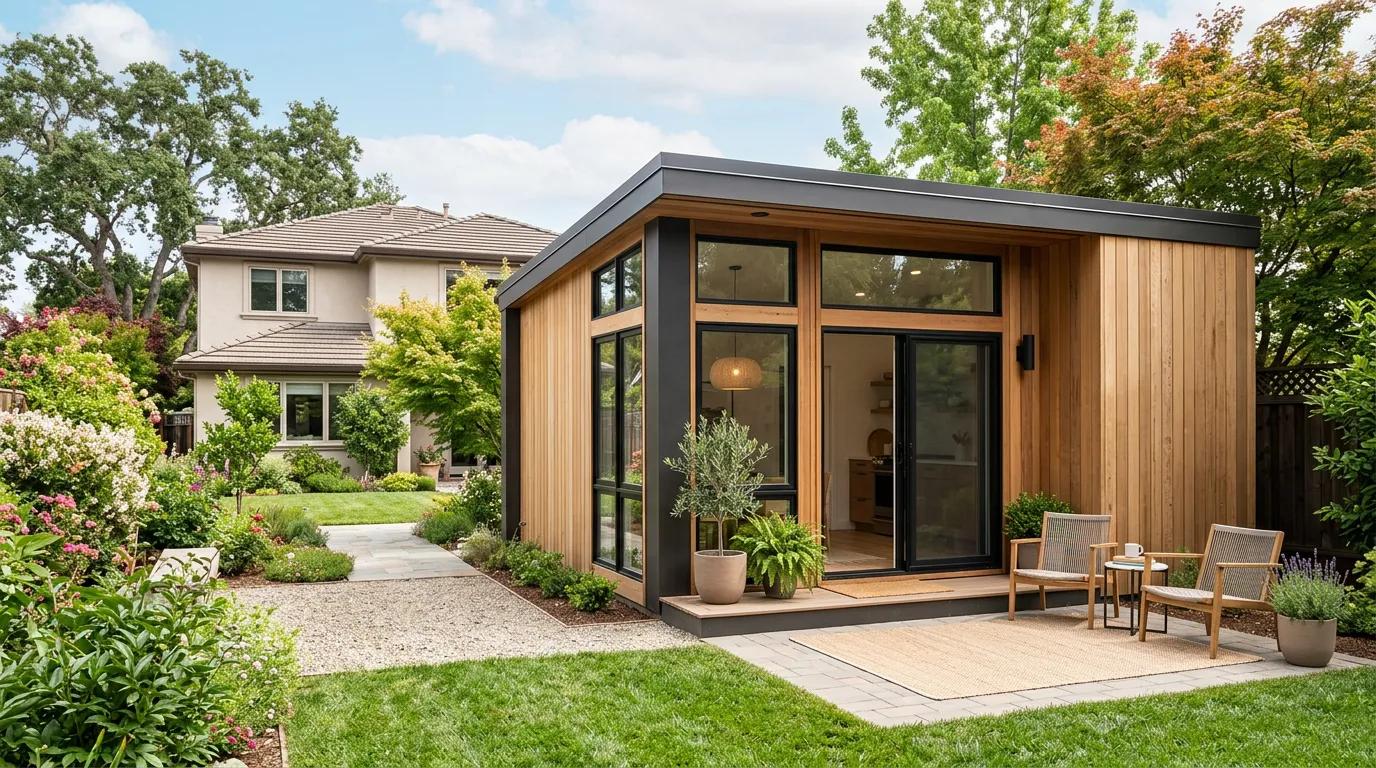
3. ADU components are heavily weighted toward short-lived property. A typical detached ADU includes appliances, cabinetry, flooring, specialty lighting, window treatments, landscaping, fencing, a new driveway or walkway, site utility connections, and outdoor lighting. These are all 5-year or 15-year property under MACRS. The structural shell (walls, roof, foundation) is a smaller percentage of total cost than in a full-size home because ADUs are compact — typically 400-1,200 square feet.
4. Site work is a larger percentage of ADU cost. ADU construction requires disproportionate site work relative to building size: utility trenching, sewer/water connections, electrical service upgrades, grading, drainage, driveway extensions, and landscaping restoration. Site improvements are 15-year property under IRC Section 1250 and qualify for 100% bonus depreciation. On a typical detached ADU, site work represents 12-18% of total construction cost — all of it accelerable.
According to Matthew Gigantelli: "The combination of clean invoices, minimal land allocation, and heavy site work makes ADUs the highest-ROI cost segregation study I do. The study practically writes itself when the builder provides organized cost records." For a detailed guide on organizing construction costs for a cost segregation study, see our construction and renovation cost segregation guide.
ADU Construction Costs by Type
ADU costs vary dramatically by type, market, and finish level. The following ranges reflect 2025-2026 construction data across major ADU markets.
| ADU Type | Typical Cost Range | Depreciable Basis (after land allocation) | Estimated Cost Seg Reclassification (25-35%) |
|---|---|---|---|
| Detached new construction | $150,000-$350,000+ | 90-95% of cost | $38K-$116K accelerated |
| Garage conversion | $80,000-$180,000 | 92-97% of cost | $20K-$60K accelerated |
| Basement conversion | $50,000-$120,000 | 95-98% of cost | $13K-$41K accelerated |
| Above-garage addition | $120,000-$250,000 | 90-95% of cost | $30K-$83K accelerated |
Notes on cost ranges:
- California averages $250+/sq ft for detached ADUs in coastal markets; interior markets run $175-$225/sq ft
- Pacific Northwest averages $200-$275/sq ft for detached new construction
- Garage and basement conversions have lower per-square-foot costs because the structural shell already exists
- Land allocation for ADUs is typically minimal (5-10%) since the land is already owned as part of the primary parcel — this is a significant advantage over purchasing a standalone rental property where land may represent 15-30% of the acquisition price
The depreciable basis advantage is one of the most overlooked benefits of ADU construction. On a $200K detached ADU with a 5% land allocation, the depreciable basis is $190,000. On a $200K condo purchase with a 25% land allocation, the depreciable basis is only $150,000. The ADU starts with $40,000 more in depreciable basis before the cost segregation study even begins.
The MACRS Breakdown for ADU Components
A cost segregation study reclassifies ADU components from the default 27.5-year residential recovery period into their correct MACRS asset classes. Here is the detailed breakdown for a typical detached ADU:
| MACRS Class | Recovery Period | ADU Components | Approx. % of Total ADU Cost |
|---|---|---|---|
| 5-year property | 5 years | Appliances (refrigerator, range, dishwasher, washer/dryer, microwave), carpet and vinyl flooring, window treatments (blinds, shades, curtains), specialty lighting fixtures, security systems, smoke/CO detectors | 8-15% |
| 7-year property | 7 years | Furniture (if furnished as rental), cabinetry (removable/freestanding), office equipment, specialty millwork | 2-5% |
| 15-year property | 15 years | Landscaping and grading, fencing and gates, driveways and walkways, site utility connections (sewer, water, gas, electric trenching), outdoor lighting, retaining walls, drainage systems, parking areas, patios and decks (detached from structure) | 12-18% |
| 27.5-year property | 27.5 years | Structural walls, roof framing and sheathing, foundation and slab, standard plumbing (in-wall), standard electrical wiring, HVAC ductwork, insulation, drywall, exterior siding, windows and doors (structural) | Remainder (62-78%) |
The critical insight: On a typical detached ADU, 22-38% of construction cost falls into 5-year, 7-year, or 15-year property. Every dollar in those categories qualifies for 100% bonus depreciation under the One Big Beautiful Bill Act — meaning it is fully deductible in the year the ADU is placed in service.
For garage and basement conversions, the accelerated percentage is often higher (30-40%) because the structural shell already exists. The conversion cost is disproportionately composed of finishes, fixtures, appliances, and site work — all short-lived property.
Matthew Gigantelli: "Investors are always surprised by how much of their ADU cost falls into 15-year property. The driveway extension, the utility trenching, the landscaping restoration, the fencing — it adds up fast. On a $200K detached ADU, I routinely see $25,000-$35,000 in 15-year site improvements alone."
The Bonus Depreciation Math: A Complete Example
Let's walk through the numbers on a real-world ADU scenario.
Property: $200,000 detached ADU, placed in service June 2026
Step 1: Establish the depreciable basis
- Total construction cost: $200,000
- Land allocation: 5% ($10,000)
- Depreciable basis: $190,000
Step 2: Cost segregation reclassification (30% accelerated)
| Component Category | % of Basis | Dollar Amount | Depreciation Method |
|---|---|---|---|
| 5-year property | 12% | $22,800 | 100% bonus depreciation |
| 7-year property | 3% | $5,700 | 100% bonus depreciation |
| 15-year property | 15% | $28,500 | 100% bonus depreciation |
| 27.5-year property | 70% | $133,000 | Straight-line over 27.5 years |
| Total depreciable basis | 100% | $190,000 |
Step 3: Calculate first-year depreciation
| With Cost Segregation | Without Cost Segregation | |
|---|---|---|
| 5-year property (100% bonus) | $22,800 | — |
| 7-year property (100% bonus) | $5,700 | — |
| 15-year property (100% bonus) | $28,500 | — |
| 27.5-year property (straight-line, half-year) | $4,836 | $6,909 |
| Total year-one depreciation | $61,836 | $6,909 |
Step 4: Tax savings comparison
| With Cost Segregation | Without Cost Segregation | |
|---|---|---|
| Year-one depreciation | $61,836 | $6,909 |
| Tax savings at 37% marginal rate | $22,879 | $2,556 |
| Tax savings at 32% marginal rate | $19,787 | $2,211 |
| Tax savings at 24% marginal rate | $14,841 | $1,658 |
The bottom line: Cost segregation produces 8.9x more depreciation in year one. At the 37% rate, that is $22,879 vs. $2,556 — an additional $20,323 in cash tax savings. The cost segregation study pays for itself 6-14x over in the first year alone.
For a detailed walkthrough of what a cost segregation study involves and how the engineering analysis works, see our DIY cost segregation study guide.
The State Conformity Problem
Federal bonus depreciation is permanent under the One Big Beautiful Bill Act. But not every state follows federal depreciation rules. If you live in a non-conforming state, your state tax return will not reflect the accelerated deductions — creating a timing difference between your federal and state tax positions.
State Conformity for Top ADU Markets
| State | ADU Activity Level | Conforms to Federal Bonus Depreciation? | State Treatment |
|---|---|---|---|
| California | Highest (20,000+ permits/year) | No | Must use standard MACRS lives for state purposes. No bonus depreciation. Creates significant federal/state timing difference. |
| Texas | High | N/A — no state income tax | Federal bonus depreciation is the full benefit. No state adjustment needed. |
| Florida | High | N/A — no state income tax | Federal bonus depreciation is the full benefit. |
| Oregon | High | Yes (with limitations) | Generally conforms but has decoupled from certain provisions historically. Verify current-year conformity. |
| Washington | High | N/A — no state income tax | Federal bonus depreciation is the full benefit. |
| Colorado | Moderate-High | Yes | Conforms to federal bonus depreciation. |
| New York | Moderate | No | Does not conform. Must depreciate over standard MACRS lives for state purposes. |
| New Jersey | Moderate | No | Does not conform. Must depreciate over standard MACRS lives for state purposes. |
| Massachusetts | Moderate | Partial | Conforms to MACRS but has historically limited bonus depreciation. Verify current-year treatment. |
| Nevada | Moderate | N/A — no state income tax | Federal bonus depreciation is the full benefit. |
The California problem is the most significant. California has the highest ADU construction volume in the nation and a top marginal state rate of 13.3%. A California ADU investor who generates $57,000 in federal bonus depreciation will receive zero accelerated state benefit — the state requires straight-line depreciation over the standard MACRS recovery periods. This does not eliminate the benefit of cost segregation (the federal savings are substantial), but it means the state tax savings are spread over 5-27.5 years rather than concentrated in year one.
For investors in no-income-tax states (Texas, Florida, Washington, Nevada), the federal bonus depreciation is the entire story. There is no state adjustment, no timing difference, and no conformity issue. The full accelerated deduction flows through to the only return that matters.
ADU Rental Classification and Passive Activity Rules
The tax benefit of cost segregation depends entirely on whether you can use the depreciation deductions. ADU rental income classification determines this.
Classification by Rental Strategy
| Rental Strategy | Average Stay | IRS Classification | Loss Treatment | Cost Seg Deduction Usability |
|---|---|---|---|---|
| Long-term rental (12+ month leases) | 365+ days | Rental activity (IRC §469) | Passive losses only | Offsets passive income only; excess carries forward |
| Mid-term rental (30-180 day stays) | 30-180 days | Rental activity (IRC §469) | Passive losses only | Offsets passive income only; excess carries forward |
| Short-term rental (under 7-day average stay) | 1-7 days | Non-rental activity if materially participating | Non-passive losses | Offsets W-2 and all active income |
The strategic implication is significant. If you build a $200K ADU and rent it long-term, the $57,000 in cost segregation deductions are passive losses. They can only offset passive income — other rental income, K-1 distributions from passive investments, etc. If you do not have sufficient passive income, the excess losses carry forward until you do (or until you sell the property).
If you build the same ADU and operate it as a short-term rental with average stays of 7 days or less, and you materially participate in the operation, the $57,000 in deductions are non-passive. They offset your W-2 salary, your bonus, your consulting income — dollar for dollar.
Three Paths to Using ADU Cost Seg Deductions Against Active Income
Path 1: The STR loophole. Furnish the ADU, list it on Airbnb/VRBO with short stays (average under 7 days), and materially participate in the management. This is the most common path for ADU investors who want to offset W-2 income. For the complete requirements, see our STR loophole requirements guide.
Path 2: Real Estate Professional Status (REPS). If you or your spouse qualifies as a real estate professional (750+ hours in real estate trades or businesses, more than any other trade or business), all rental losses become non-passive. This works regardless of rental strategy — long-term, mid-term, or short-term.
Path 3: Passive income offset. If you have other rental properties generating positive cash flow, the ADU's passive losses offset that income. This is less dramatic than the STR loophole but still valuable — particularly for investors with a portfolio of stabilized rentals.
For mid-term rental operators (30-180 day stays), the activity is classified as rental under IRC §469 regardless of material participation. The cost seg deductions are passive. For a detailed analysis of MTR tax treatment, see our mid-term rental tax strategy guide.
When to Order the Cost Segregation Study
Best practice: Order the study DURING construction, not after the ADU is completed.
This is the single most actionable recommendation in this guide. Most ADU investors wait until the unit is placed in service, then retroactively order a cost segregation study. This works — but it leaves money on the table.
Why Ordering During Construction Produces Better Results
1. Real-time invoice review. When the cost segregation engineer reviews invoices as they come in, they can flag components that are being lumped together by the general contractor. A single invoice line item for "kitchen — $28,000" gets broken down into cabinetry (5-year), countertops (27.5-year), appliances (5-year), flooring (5-year), lighting (5-year), and plumbing fixtures (27.5-year). Without real-time review, these components often stay lumped together and default to 27.5-year property.
2. Blueprint analysis before construction begins. Engineers can review architectural plans and identify accelerable components before they are installed and covered up. Underground utility runs, embedded electrical conduit, and sub-slab plumbing are all easier to classify and quantify from blueprints than from post-construction inspection.
3. Photo documentation during construction. Components that are visible during construction (framing, rough plumbing, electrical runs, insulation, site work) become invisible after drywall and finish work. Photos taken during construction provide documentation that supports higher reclassification rates and strengthens audit defense.
4. Garage and basement conversions require pre-demolition documentation. For conversions, the engineer needs to document the existing structure before demolition begins. This establishes the basis for partial asset disposition — deducting the remaining undepreciated value of components that are removed and replaced. Without pre-demolition documentation, these deductions are difficult to support.
Timeline for Ordering
| ADU Type | When to Order | Why |
|---|---|---|
| Detached new construction | When foundation is poured or framing begins | Allows blueprint review and construction-phase photo documentation |
| Garage conversion | Before demolition of existing garage interior | Documents existing components for partial asset disposition |
| Basement conversion | Before demolition of existing basement finishes | Documents existing components for partial asset disposition |
| Above-garage addition | When framing begins | Allows structural vs. non-structural component identification |
Matthew Gigantelli: "I tell every ADU builder the same thing — call me when you pull the permit, not when you get the certificate of occupancy. The studies I complete during construction consistently reclassify 3-5 percentage points more than post-completion studies on identical property types. On a $200K ADU, that is an additional $6,000-$10,000 in first-year deductions."
Frequently Asked Questions
Q: Is cost segregation worth it on an ADU that costs less than $150,000?
A: For ADUs above $75,000, cost segregation almost always produces meaningful savings. A $100,000 garage conversion with 30% reclassification produces approximately $30,000 in first-year bonus depreciation — worth approximately $11,100 in tax savings at the 37% rate. Even with a study cost of $1,500-$2,500, the ROI is 4x-7x. For ADUs under $50,000, the savings may not justify the study cost unless combined with a cost segregation study on the primary property.
Q: Can I do cost segregation on an ADU attached to my primary residence?
A: Yes, but only on the ADU portion that is used as a rental. The ADU must be a separate, identifiable unit used for rental purposes. The cost segregation study applies only to the ADU's construction costs, not to the primary residence. If the ADU shares structural components with the primary residence (such as an above-garage addition), the engineer will allocate costs between the rental and personal-use portions. Practical separation guidance: For detached ADUs, the separation is straightforward — the ADU has its own foundation, structure, and utility connections, and the cost segregation study covers only the ADU construction costs. For attached ADUs (above-garage additions, basement conversions), the engineer must allocate shared structural components between the personal-use primary residence and the rental ADU. This allocation is typically based on square footage ratios, but components that serve only the ADU (its dedicated HVAC zone, dedicated electrical sub-panel, dedicated plumbing runs) are allocated 100% to the ADU. Shared components (roof over an above-garage ADU, foundation under a basement ADU) are allocated proportionally. If you are building an attached ADU, provide your cost segregation engineer with architectural plans showing the ADU boundary and any shared structural elements — this enables precise allocation from the start.
Q: Does the ADU need to be rented before I can claim depreciation?
A: The ADU must be "placed in service" — meaning it is ready and available for rental use. It does not need to have a tenant on day one. Once the certificate of occupancy is issued and the unit is listed for rent or available on a rental platform, depreciation begins. The placed-in-service date determines the tax year in which bonus depreciation is claimed.
Q: What if I use the ADU for personal use part of the year?
A: Personal use days reduce the rental deduction. Under IRC Section 280A, if personal use exceeds the greater of 14 days or 10% of rental days, the property is treated as a personal residence and rental deductions are limited to rental income. For cost segregation to produce maximum benefit, the ADU should be used exclusively (or nearly exclusively) as a rental.
Q: How does cost segregation interact with the ADU tax credit in California?
A: California's ADU grant and incentive programs (such as CalHFA's ADU Grant Program) reduce the owner's cost basis by the amount of the grant. If you receive a $40,000 grant on a $200,000 ADU, your depreciable basis starts at $160,000 (minus land allocation), not $200,000. Cost segregation applies to the net basis after grants. The federal cost segregation benefit is unaffected by state grant programs — it applies to whatever depreciable basis remains.
The Bottom Line: ADUs Are the Highest-ROI Cost Segregation Target
ADUs combine every factor that makes cost segregation effective: clean construction records, minimal land allocation, heavy weighting toward short-lived components, and disproportionate site work. The result is reclassification rates that consistently exceed standard residential acquisitions.
On a $200K detached ADU, cost segregation with 100% bonus depreciation produces $50,000-$70,000 in first-year deductions. Without cost segregation, that same ADU generates $6,909 per year. The difference is not incremental — it is transformational.
For ADU investors who qualify for the STR loophole through short-term rental operation with material participation, these deductions offset W-2 income dollar for dollar. For long-term rental operators, the deductions offset passive income and carry forward indefinitely.
The study costs $1,500-$3,500. The first-year benefit is $18,000-$26,000+ in cash tax savings. The ROI is 5x-17x. There is no other line item in your ADU construction budget that produces this kind of return.
Your next steps:
- Run your estimate. Use Overline's cost seg estimate tool to see your ADU-specific savings in 60 seconds.
- Order during construction. If your ADU is under construction, order the study now — not after completion. The reclassification rates are 3-5 percentage points higher.
- Confirm your rental strategy. If you want to offset W-2 income, review the STR loophole requirements and plan to operate the ADU as a short-term rental with material participation.
- Talk to your CPA. Bring them the estimate and confirm your passive activity classification. If your CPA has not raised cost segregation, bring them the data.
- Plan for state taxes. If you are in California, New York, or New Jersey, understand that state bonus depreciation does not apply. Model the federal and state benefits separately.
Matthew Gigantelli: "Every ADU I study reinforces the same conclusion — this is the most cost-seg-friendly property type in residential real estate. The records are clean, the components are accelerable, and the land allocation is minimal. If you are building an ADU and not ordering a cost segregation study, you are leaving $20,000+ in tax savings on the table."
For a quick cost segregation estimate on your property, try Modern CFO's free calculator. For ADU-specific cost segregation strategies, see Modern CFO's ADU cost segregation guide.
Overline delivers technology-enabled, low-cost engineering-based cost segregation studies with lifetime audit defense. Over 3,000 properties studied, $200M+ in accelerated depreciation identified. Get your free personalized estimate at overlineiq.com/cost-segregation-estimate.
See Your Property's Tax Savings
Drop your address. The AI estimates your depreciation savings in 60 seconds, backed by a certified engineer study.

Free cost segregation estimate, engineer-certified studies, and ongoing depreciation tracking.
Backed by $1B+ in supported tax depreciation.