

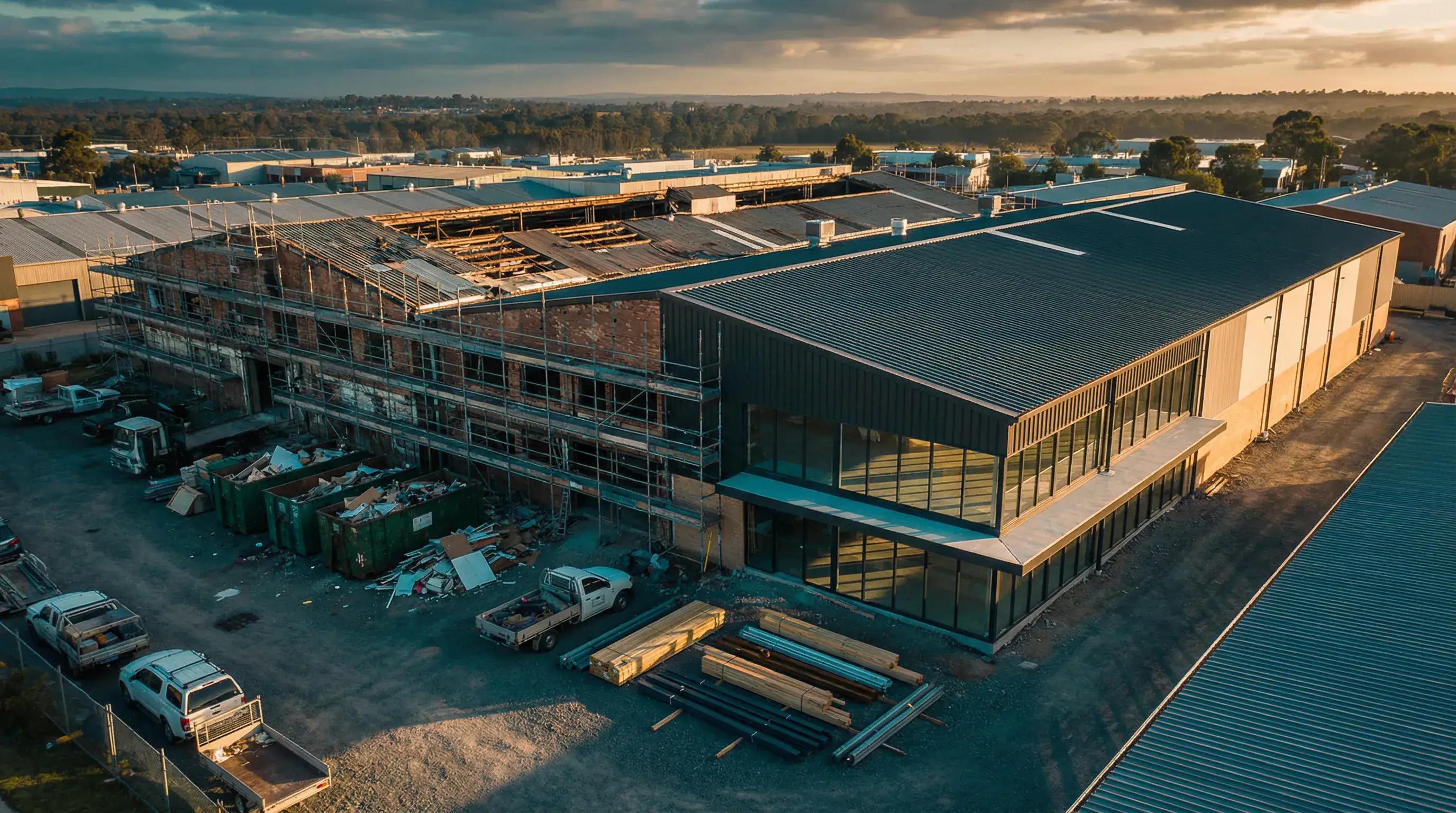
The "Triple-Dip" Renovation Strategy
Most business owners miss this: When you renovate your building, you can actually deduct MORE than you spend—sometimes in the same year.
How? By combining three tax strategies:
- Write off the old stuff you're replacing
- Accelerate depreciation on the new stuff
- Take the 100% bonus depreciation allowance immediately, if the property was acquired and placed in service after January 19, 2025
Real example: $500K renovation → $425K in year-one deductions → $157K tax savings (at 37% rate)
That makes the renovation cost, after taxes, only $343K. Let me show you exactly how this works.
Author’s note (Overline): We’ve engineered “triple‑dip” plans on office, restaurant, and retail renovations—figures here mirror what underwriters and auditors actually accept.
The Three Strategies Explained
Strategy #1: Partial Asset Disposition (PAD) - Write Off the Old
What it is: When you replace building components, write off the remaining value of the old ones immediately.
Example: You're replacing a 10-year-old HVAC system that originally cost $100K. After 10 years of depreciation, it still has $65K of value left on your books.
Normal approach: Keep depreciating that $65K over the next 29 years.
PAD approach: Write off the full $65K this year.
Strategy #2: Cost Segregation - Accelerate the New
What it is: Break down your renovation costs to identify what can be written off faster.
Example: Your $500K renovation includes:
- HVAC, electrical, lighting: $300K (can be written off in 5-15 years)
- Structural work: $200K (must be written off over 39 years)
A cost segregation study identifies which is which.
Strategy #3: 100% Bonus Depreciation for Property Acquired After January 19, 2025
What it is: Take the components that qualify for faster depreciation and write off 100% immediately.
Example: That $300K in HVAC/electrical/lighting from above? With bonus depreciation (made permanent by the One Big Beautiful Bill Act), you deduct the entire $300K in year one.
The "Triple Dip": Putting It All Together
Your $500K office renovation:
Step 1 - PAD: Write off old components
- Old HVAC, electrical, flooring (still on your books): $125K
- Immediate deduction: $125K
Step 2 - Cost Seg: Identify fast-depreciation items
- New HVAC, electrical, flooring, lighting: $300K
- Structural improvements: $200K
Step 3 - Bonus: Write off qualifying items immediately
- $300K × 100% bonus depreciation (property acquired and placed in service after January 19, 2025)
- Immediate deduction: $300K
Total year-one deductions: $425K on a $500K renovation
Tax savings: $425K × 37% = $157,250
Net cost after tax: $500K - $157K = $343K
You just made your renovation 31% cheaper through tax savings.
When to Do the Cost Segregation Study
Best: Before renovation starts
- Identify what you'll be removing (for PAD)
- Plan the renovation around tax benefits
- Get maximum documentation
Good: During renovation
- Document components as you remove them
- Track costs in real-time
- Easier to prove everything
Still works: After renovation
- Can still be done via Form 3115
- Harder to reconstruct details
- Better than nothing!
Real Examples: Different Business Types
Restaurant ($350K Renovation)
The work: Dining room refresh, new kitchen equipment, bar renovation
The breakdown:
- Remove old equipment (PAD): $80K deduction
- New 5-year property: $210K × 100% bonus = $210K deduction
- QIP improvements: $60K × 100% bonus = $60K deduction
- Total deduction: $350K
Tax savings: $350K × 35% = $122,500
Office Building ($800K Renovation)
The work: New HVAC, lighting, flooring, bathroom upgrades
The breakdown:
- Remove old systems (PAD): $175K
- New components (5-15 year): $520K
- Structural (39-year): $280K
- Eligible for immediate deduction: $695K
Tax savings: $695K × 37% = $257,150
Retail Store ($600K Buildout)
The work: Complete store renovation, new fixtures, lighting, POS
The breakdown:
- Old fixtures (PAD): $25K
- Tenant improvements: $425K
- Everything qualifies for bonus
- Total deduction: $450K
Tax savings: $450K × 35% = $157,500
Your Implementation Checklist
Before You Start Renovating
✓ Hire a cost segregation specialist
✓ Identify what you're replacing (for PAD)
✓ Get documentation of existing components
✓ Plan renovation timing
✓ Talk to your CPA about the strategy
During Renovation
✓ Take photos of components before removing them
✓ Track costs separately (HVAC separate from painting, etc.)
✓ Save all contractor invoices
✓ Document when each component is "placed in service"
✓ Keep a renovation journal with dates
After Renovation
✓ Give cost seg report to your CPA
✓ File Form 3115 (if first-time PAD election)
✓ File Form 4562 (for bonus depreciation)
✓ Update your fixed asset schedule
✓ Keep all documentation for 7+ years
Common Mistakes
❌ Not getting a cost seg study - Leaving money on the table
❌ Forgetting about the old components - Missing PAD deductions
❌ Poor documentation - Can't defend it in an audit
❌ Doing it yourself - Almost always misses opportunities
Common Questions
Q: Can I do this myself without hiring professionals?
A: Not recommended. A cost seg study costs $5K-$15K but typically generates $100K-$500K in deductions. The ROI is 10-50x. DIY usually misses opportunities and creates audit risk.
Q: What if I already renovated last year?
A: You can still claim the benefits retroactively by filing Form 3115 with your tax return. Talk to your CPA about "catch-up depreciation."
Q: Does this work for residential rental properties?
A: Yes! Cost segregation and PAD work for both commercial and residential rental properties.
Q: How long do I have to make the PAD election?
A: You should file it with your tax return for the year you removed the components. Late elections are possible but more complex.
Q: Is this legal and audit-safe?
A: Yes, when done correctly with professional engineering studies. These are legitimate IRS-approved strategies. Just keep good documentation.
Ready to Save on Your Next Renovation?
Your action plan:
- Planning a renovation? Call a cost segregation specialist BEFORE you start
- Already renovating? Document everything and get a cost seg study now
- Already finished? You might still be able to claim retroactive benefits
The bottom line: These three strategies combined can cut your renovation's after-tax cost by 30-50%. That's real money back in your business.
Learn More
For a quick cost segregation estimate, try Modern CFO's free calculator. For renovation-specific cost segregation strategies, see Modern CFO's renovation cost segregation guide.
Disclaimer: Educational purposes only. Work with qualified tax and engineering professionals for implementation.
Sources
- Treasury Regulation §1.168(i)-8 — Partial Asset Dispositions: https://www.law.cornell.edu/cfr/text/26/1.168(i)-8
- 26 U.S.C. §168(k) — Bonus depreciation: https://www.law.cornell.edu/uscode/text/26/168
- IRS Publication 946 — How to Depreciate Property: https://www.irs.gov/publications/p946
- Form 3115 instructions — Accounting Method Change: https://www.irs.gov/forms-pubs/about-form-3115
- Form 4562 — Depreciation and Amortization: https://www.irs.gov/forms-pubs/about-form-4562
