

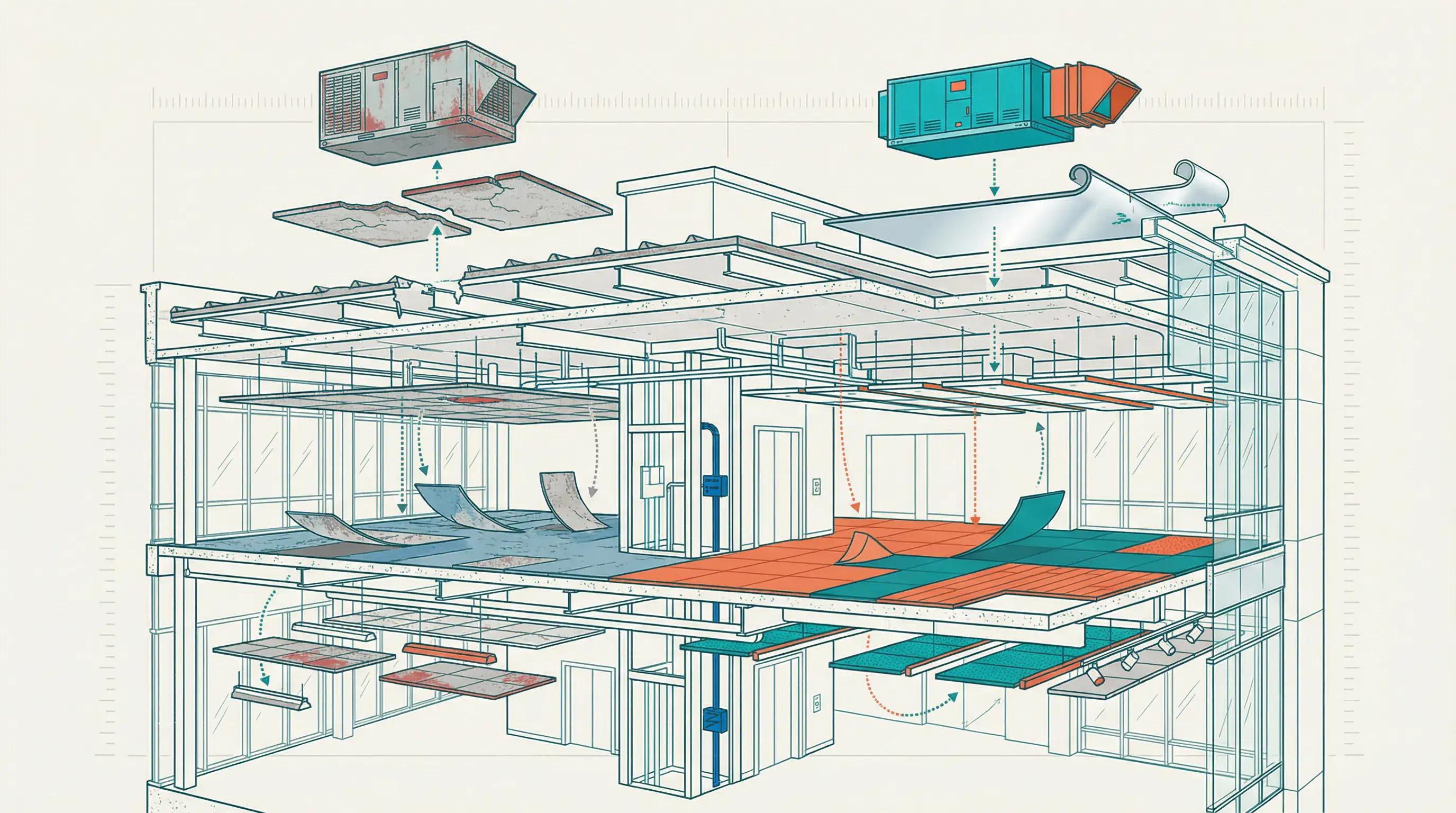
The Replacement Deduction Most Property Owners Miss
Here's a tax strategy most people don't know exists:
When you replace a major building component (roof, HVAC, flooring, etc.), you can immediately write off whatever depreciation is left on the old one.
Most people don't do this. They just keep depreciating the old component (that no longer exists!) while also depreciating the new one.
The smart move: Use Partial Asset Disposition (PAD) to claim an immediate deduction on the old component's remaining value—often tens of thousands of dollars.
Combined with cost segregation and bonus depreciation, this creates what I call the "triple dip" that can generate deductions exceeding your actual spending.
Author’s note (Overline): We’ve advised on dozens of PAD elections and Form 3115 filings; the steps here reflect what consistently clears review in practice.
What is Partial Asset Disposition (PAD)?
Simple explanation: When you replace part of your building, you can write off what's left of the old part immediately instead of continuing to depreciate it over decades.
How it started: The IRS created this rule in 2014 to fix a problem—people were depreciating both the old (removed) component AND the new component at the same time. That's double-dipping.
The solution: PAD lets you write off the old component immediately, then depreciate the new one fresh.
Real Example: HVAC Replacement
Your situation:
- Bought office building in 2015 for $2M
- Cost segregation identified HVAC at $200K
- 10 years later (2025): HVAC needs replacing
The math on your old HVAC:
- Original cost: $200K
- Depreciation taken over 10 years: $120K
- Remaining value on your books: $80K
Your two options:
Without PAD (the wrong way):
- Keep depreciating that $80K over 29 more years
- That's $2,759 per year
- Also depreciate new $300K system
With PAD (the right way):
- Write off the $80K immediately this year
- Plus: 100% bonus depreciation on the new $300K system, acquired and placed in service after January 19, 2025
- Total year-one deduction: $380K
Tax savings difference: $380K × 37% = $140,600 in immediate tax savings vs. spreading it over decades.
How to Use PAD: The Simple Process
Step 1: Identify what you're replacing
- Roof, HVAC, flooring, electrical, plumbing, etc.
Step 2: Find its original cost and remaining value
- Look at your cost segregation study (if you have one)
- Or review your original purchase records
- Calculate: Original cost - depreciation taken = remaining value
Step 3: Make the PAD election
- Tell your CPA you want to make a PAD election
- They'll file Form 3115 (if it's your first time)
- Claim the remaining value as a deduction
Step 4: Depreciate the new component
- Fresh depreciation schedule on the replacement
- Potentially 100% bonus depreciation if it qualifies, meaning it was acquired and placed in service after January 19, 2025
When You MUST Use PAD (Mandatory Situations)
The IRS requires PAD in these situations:
- Casualty loss (fire, storm damage)
- 1031 exchanges
- Selling a portion of a property
- Involuntary conversions
Why it matters: If you're in these situations, you have to use PAD whether you want to or not.
When You CAN Use PAD (Elective Situations)
You get to choose whether to use PAD when:
- Voluntarily replacing building components
- Upgrading systems
- Renovating
- Removing tenant improvements
Smart move: Almost always elect PAD when replacing components. The immediate deduction beats slow depreciation.
Why You Need Cost Segregation for PAD
Here's the problem: To use PAD, you need to know the original cost of the component you're replacing.
Where do you get that? From a cost segregation study.
What a cost seg study does:
- Breaks your building into individual components (HVAC, electrical, plumbing, flooring, etc.)
- Assigns a cost to each component
- Gives you the documentation you need for PAD
Without a cost seg study:
- You can try to estimate component values
- But it's much harder to defend in an audit
- You'll probably miss opportunities
With a cost seg study:
- Clear documentation of every component
- Professional engineering support
- Maximum defensibility
- Often identifies more components than you'd find yourself
Bottom line: Cost segregation + PAD work together. Get the cost seg study first, then use PAD every time you replace something.
Why Use PAD When the 100% Allowance Already Applies?
Good question. If the property is on the 100% branch, acquired after January 19, 2025, why bother with PAD?
Answer: They work together to create "double" deductions.
The combination:
- PAD: Write off remaining value of OLD component (say, $80K)
- Bonus: Write off 100% of NEW component (say, $300K)
- Total: $380K in deductions
Without PAD:
- Only get deduction on new component: $300K
- Lost: $80K deduction
That $80K difference = $29,600 in tax savings (at 37% rate)
Common Questions
Q: Do I need a cost segregation study to use PAD?
A: Technically no, but practically yes. Without a cost seg study, you won't know the original cost of components you're replacing. And without that, you can't calculate the PAD deduction.
Q: Can I use PAD on properties I bought years ago?
A: Yes! You can do a cost segregation study now (even if you bought the building 10 years ago), then use PAD whenever you replace components going forward.
Q: What if I never did cost segregation—can I still claim PAD?
A: You can file Form 3115 to do a retroactive cost segregation study, then start using PAD. You'll catch up on missed depreciation too.
Q: Is this risky or aggressive?
A: No. PAD is explicitly allowed by IRS regulations (Treasury Regulation 1.168(i)-8). With proper documentation, it's completely audit-safe.
Q: What's the ROI?
A: Combined with cost segregation, PAD typically provides 10-50x ROI. $10K in professional fees often generates $100K-$500K in deductions.
Your Action Plan
Before your next renovation:
- Get a cost segregation study (if you don't have one)
- Identify what you'll be replacing
- Calculate the PAD deduction you'll get
- Plan the project with your CPA
When you replace components:
- Document what you removed (photos)
- Tell your CPA to make PAD election
- File Form 3115 (if first time)
- Claim the deduction
The bottom line: PAD + cost segregation + bonus depreciation = triple benefits on renovations.
Don't leave money on the table.
Learn More
- Cost Segregation and Insurance: What Your Provider Isn't Telling You — Why PAD events should trigger insurance updates
- Cost Segregation Legal Guide — Court cases and audit defense strategies
- Renovation Tax Strategy
- Cost Segregation vs. Straight-Line Depreciation — Side-by-side comparison
- 10 Depreciation Secrets
Sources
- Treasury Regulation §1.168(i)-8 — Partial Asset Dispositions: https://www.law.cornell.edu/cfr/text/26/1.168(i)-8
- IRS Publication 946 — How to Depreciate Property: https://www.irs.gov/publications/p946
- Form 3115 instructions — Change in Accounting Method (depreciation/PAD): https://www.irs.gov/forms-pubs/about-form-3115
Disclaimer: Educational content only. Work with qualified tax professionals for implementation.
For a quick cost segregation estimate on your property, try Modern CFO's free calculator. For a detailed partial asset disposition analysis, see Modern CFO's partial asset disposition guide.
See Your Property's Tax Savings
Drop your address. The AI estimates your depreciation savings in 60 seconds, backed by a certified engineer study.

Free cost segregation estimate, engineer-certified studies, and ongoing depreciation tracking.
Backed by $1B+ in supported tax depreciation.