

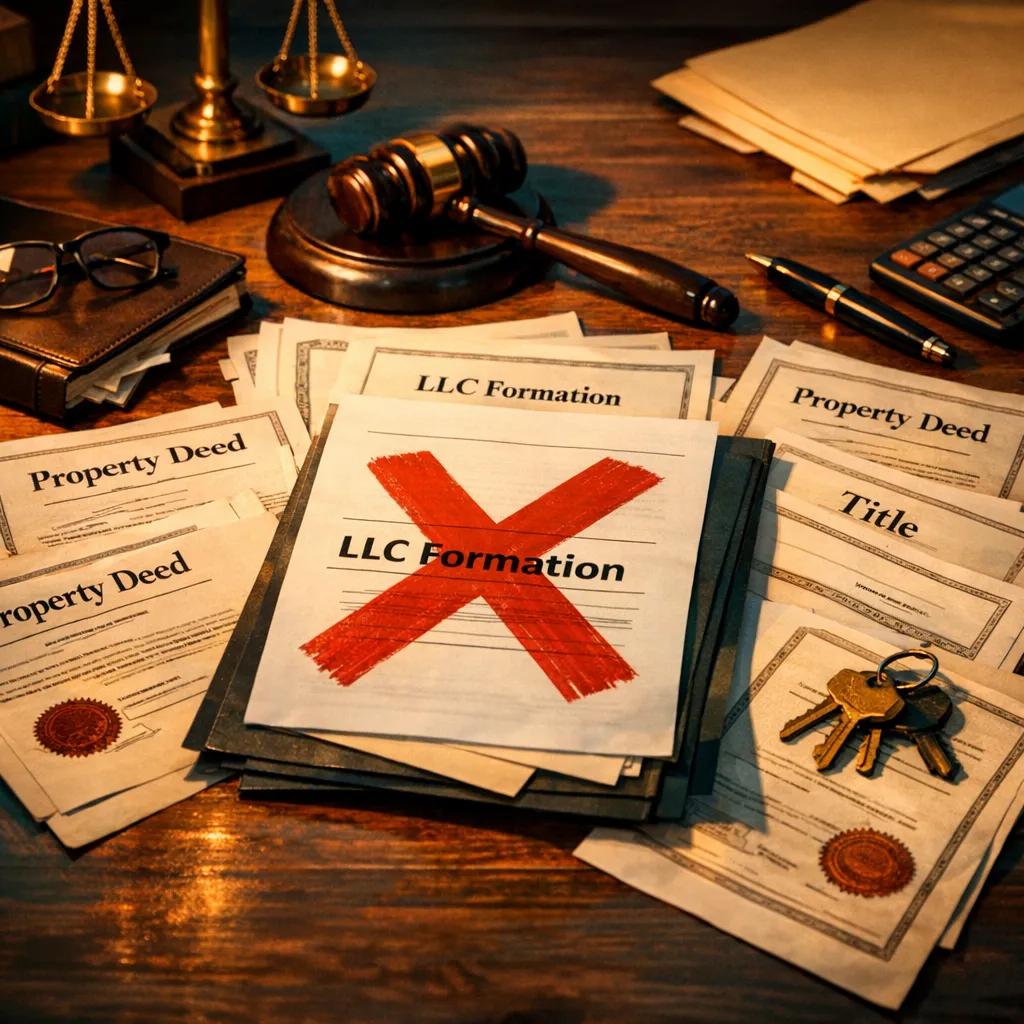
"Efficiency" Is Quietly Destroying Portfolios
Investors reuse LLCs because:
- It's cheaper
- Bookkeeping feels easier
- Advisors don't object
- "One entity is simpler"
This is one of the most dangerous efficiency decisions in real estate.
The money saved on LLC formation fees is trivial compared to the exposure created when multiple properties share a single legal wrapper. We see this mistake constantly — and by the time investors realize it, the damage is often irreversible.
Author's note (Overline): Entity reuse is the structural mistake we encounter most frequently. Investors who are otherwise sophisticated — running detailed cost segregation analyses, timing acquisitions carefully, managing cash flow precisely — undermine everything with a single LLC holding multiple properties. This article explains why it matters and what to do instead.
How Entity Reuse Multiplies Risk
When multiple properties share one entity:
- Liabilities stack — every property's risk adds to the same pool
- Equity cross-collateralizes — a judgment against one property reaches all equity
- Income streams lose isolation — litigation can freeze all rental income, not just one property's
One lawsuit no longer threatens one deal. It threatens all deals. This is the practical consequence of how LLC liability shields work under the Uniform Limited Liability Company Act (ULLCA §304) — the entity's assets are the first pool reached by any judgment creditor, and when all your properties sit in one pool, that shield becomes a liability.
| Properties in Entity | Equity at Risk from Single Lawsuit | Income at Risk |
|---|---|---|
| 1 property | ~$300k–$500k | $2k–$4k/month |
| 3 properties | ~$900k–$1.5M | $6k–$12k/month |
| 5 properties | ~$1.5M–$2.5M | $10k–$20k/month |
| 10 properties | ~$3M–$5M+ | $20k–$40k/month |
Same lawsuit. Same slip-and-fall. Same contractor dispute. The blast radius is determined by entity structure, not by the severity of the incident.
Why This Mistake Isn't Obvious
Nothing goes wrong for years.
The portfolio performs well. Rents come in. Tax strategies work. The investor feels smart and efficient.
Until:
- A contractor sues over a renovation dispute
- A tenant claims injury from a known defect
- A short-term rental guest is injured
- A building code violation surfaces
- An employee files a claim
Then everything fails at once.
The investor didn't pick a bad deal. They didn't ignore due diligence. They didn't take on too much leverage. They reused an entity — and turned an isolated incident into a portfolio-wide crisis.
This is the pattern we described in The #1 Reason Investors Lose Everything: structure failure, not market risk, is what ends careers.
Disregarded Entities Are Meant to Be Disposable
Under IRC §7701 and Treasury Regulation §301.7701-3, single-member LLCs are treated as "disregarded entities" for federal tax purposes — meaning they don't file separate returns. But from a liability perspective, they serve a critical function:
- Wrappers — lightweight containers for individual assets
- Isolation tools — designed to contain damage to a single property
- Sacrificial compartments — expendable by design
They are not:
- Vaults for your entire portfolio
- Holding companies
- Efficiency vehicles
- Places to pile assets
Good structures assume failure somewhere. If losing one entity scares you, your structure is wrong. The whole point of per-property isolation is that one entity can absorb a loss — protected by charging order limitations (ULLCA §503, recognized in all 50 states) — while the rest of the portfolio continues operating.
The Math of Entity Reuse vs. Isolation
Investors resist multiple entities because of cost. Let's look at the actual math:
| Consideration | Single Entity (5 properties) | Separate Entities (5 LLCs) |
|---|---|---|
| Formation cost | ~$500 one-time | ~$2,500 one-time ($500 × 5) |
| Annual maintenance | ~$200/year | ~$1,000/year |
| Bookkeeping complexity | Lower | Moderate (but automatable) |
| Equity at risk per incident | $1.5M–$2.5M (all properties) | $300k–$500k (one property) |
| Income frozen per incident | All rental income | One property's income |
| Recovery time | Years | Months |
The cost difference is ~$800/year. The risk difference is $1M+ in exposure.
No rational investor would pay $800/year to take on $1M+ in additional liability — but that's exactly what entity reuse does. The "savings" are visible. The risk is invisible until it materializes.
The Titling Trap
Entity reuse often compounds with titling errors — another underrated risk:
- Property titled in the wrong entity "temporarily"
- Property held personally while LLC formation is "in process"
- IRA-owned property held directly instead of through an IRA-owned LLC
- Wrong manager listed on the entity
- Wrong order of formation
The deal didn't fail. Execution failed.
99% of strategies work. It's the 1% of execution mistakes that destroy them. The IRS didn't kill the deal — titling did.
Operating Agreements: The Silent Vulnerability
Most investors use boilerplate operating agreements. Courts have repeatedly examined operating agreements in veil-piercing analyses — looking at whether formalities were observed, whether the agreement reflects actual operations, and whether it provides adequate separation between entity and owner (Walkovszky v. Carlton, 18 N.Y.2d 414; Perpetual Real Estate Services v. Michaelson Properties, 974 F.2d 545). These often contain clauses that help creditors:
- Forced distributions — creditors can compel cash payouts (states vary — Wyoming and Nevada provide the strongest protections under their revised LLC acts)
- Pro-rata payouts — creditors access income proportionally
- Manager removal — creditors can replace management
- Mismatched tax elections — creating unintended tax consequences under IRC §7701
Most operating agreements are written for convenience, not defense. A properly drafted operating agreement is a defensive weapon. A boilerplate one is a liability.
What Proper Entity Isolation Looks Like
The Basic Framework
- One property per LLC — each property in its own single-member LLC
- Holding company above — a parent entity (often Wyoming LLC) owns the individual property LLCs
- Operating entity separate — property management, STR operations, and construction activities in their own entities
- Anonymity layer — holding company provides privacy so individual properties aren't easily traced to you personally
Why This Works
- A lawsuit against one property only reaches that LLC's assets
- Other properties continue operating unaffected
- Income from unaffected properties continues flowing
- You maintain negotiating leverage (shallow pockets in the target entity)
- Exit optionality is preserved — you can sell individual entities cleanly
How Entity Structure Protects Your Tax Savings
This is where entity reuse directly undermines cost segregation:
You spend time and money on an IRS-compliant study. You capture 24%, 44% reclassification. You take 100% bonus depreciation for property acquired after January 19, 2025 in year one. You save $50,000, $100,000+ in taxes.
Then a lawsuit against one property freezes all income across your shared entity — including the cash flow those tax savings were meant to protect.
Proper entity isolation means your tax strategy and your liability protection work together instead of against each other. This is what we mean by real optimization.
Frequently Asked Questions
Q: How many LLCs do I actually need? A: The general principle is one LLC per property for asset isolation. The optimal structure depends on your portfolio size, state laws, risk profile, and operational complexity. Some investors use series LLCs where available. The key question isn't "how many entities do you have?" — it's "what fails if one breaks?"
Q: Isn't managing multiple LLCs a bookkeeping nightmare? A: It adds some complexity, but modern accounting tools make it manageable. Many investors use separate bank accounts per entity with automated bookkeeping. The additional effort is minimal compared to the protection provided. At $800/year in extra costs vs. $1M+ in risk reduction, the math is clear.
Q: Can I restructure if I already have multiple properties in one LLC? A: Often yes, but the timing and method matter. Moving properties between entities has tax and legal implications that need to be handled carefully. The key is doing it proactively — before any incident — because courts routinely disregard restructuring done after a triggering event. Consult a qualified attorney.
Q: Does entity isolation affect my ability to get cost segregation studies? A: Not at all. Cost segregation studies are performed on individual properties regardless of entity structure. In fact, per-property entities make the studies cleaner — each study maps directly to one entity's depreciation schedule. This simplifies tax filing and improves audit defensibility.
Q: What about series LLCs? Are they a good alternative? A: Series LLCs offer similar isolation benefits with lower formation costs in states that recognize them. The Uniform Protected Series Act (2017) provides a model framework, and states like Delaware (6 Del. C. §18-215), Illinois, Texas, and Nevada have adopted series LLC statutes. They can be effective, but they have limitations: not all states recognize series LLC protections, and some lenders are unfamiliar with the structure. They're a valid tool — but not a universal solution.
See Your Property's Tax Savings
Drop your address. The AI estimates your depreciation savings in 60 seconds, backed by a certified engineer study.

Free cost segregation estimate, engineer-certified studies, and ongoing depreciation tracking.
Backed by $1B+ in supported tax depreciation.
Continue Reading
Explore more guides from our library:
- The #1 Reason Investors Lose Everything — Why structure failure ends careers
- Cost Segregation Without Structure Is Fake Optimization — Why tax savings alone isn't enough
- Cost Segregation and Insurance: What Your Provider Isn't Telling You — Coverage gaps that compound structural risk
- Cost Segregation for W-2 Earners Making $250K+ — The complete guide for high-income professionals
- Cost Segregation Legal Guide — Court cases and audit defense strategies
Disclaimer: This content is for informational purposes only and does not constitute legal, tax, or financial advice. Entity structuring and asset protection depend on your specific circumstances, state laws, and individual risk profile. Consult qualified legal and tax professionals regarding your specific situation.