

About the Author
This guide was written by Matthew Gigantelli, a cost segregation engineer and real estate tax strategist at Overline who has completed engineered studies on over 3,000 properties across every residential property type — from single-family rentals to 200+ unit apartment complexes. Gigantelli holds a B.A. in Finance (summa cum laude) from Rasmussen University and a certification from Boon Tax Educators (2026).
Matthew Gigantelli on multifamily vs. single-family cost segregation: "When investors compare a single-family rental to a duplex or fourplex, they run the rent comps, the cap rate, the debt service coverage. Almost nobody runs the cost segregation comparison. On two $500K properties, the multifamily option routinely produces $20,000-$50,000 more in first-year accelerated depreciation. That is not a rounding error — it is the variable that changes which property you should buy."
The Variable Nobody Models
When investors compare single-family rentals to small multifamily properties — duplexes, triplexes, and fourplexes — they focus on the metrics that real estate education teaches them to focus on: gross rent multiplier, cap rate, cash-on-cash return, debt service coverage ratio, and financing terms. These are the right metrics. They are also incomplete.
The variable that almost nobody models is cost segregation potential. And it is the variable that can swing the first-year tax benefit by $20,000-$50,000 on a single acquisition.
Data from 8,000+ engineered cost segregation studies shows a consistent pattern: multifamily properties achieve higher reclassification percentages than single-family homes. Not marginally higher — structurally higher. The typical single-family rental reclassifies 24-34% of depreciable basis into 5-year and 15-year property. The typical small multifamily reclassifies 28-38%. That four-to-eight percentage point gap is not noise. It is a structural advantage driven by components that exist in multifamily properties and do not exist in single-family homes.
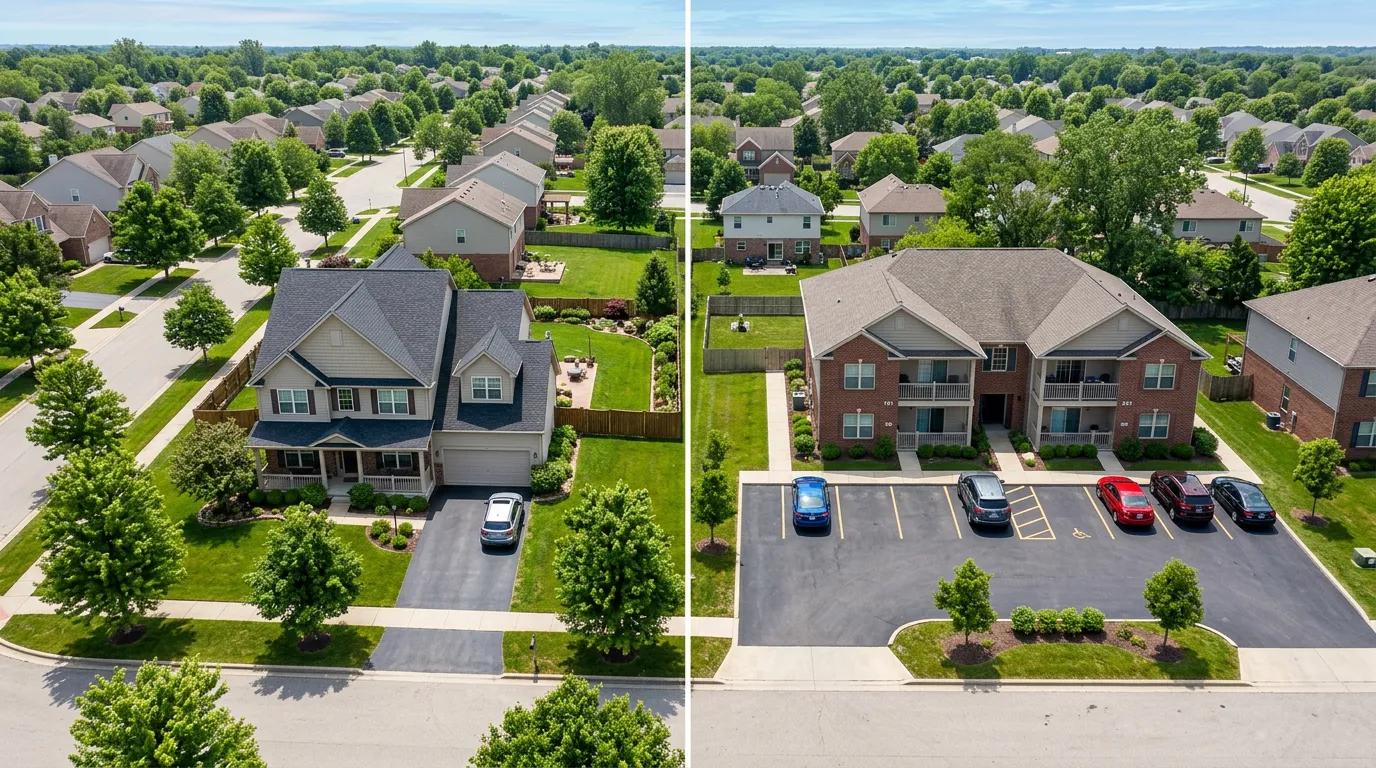
The reason is common-area components. Parking lots. Shared landscaping. Laundry rooms. Fitness areas. Leasing offices. Pool decks. Common-area lighting and security systems. Signage. These are all depreciable assets that fall into 5-year or 15-year MACRS categories — and single-family homes have none of them.
This guide presents the data, walks through the dollar impact, and explains how to incorporate cost segregation potential into your acquisition analysis before you buy — not after.
Key Takeaways
- Multifamily properties: 28-38% typical reclassification to 5/15-year property
- Single-family rentals: 24-34% typical reclassification
- The 4-8 percentage point gap comes from common-area components (parking, landscaping, laundry, fitness areas)
- On a $500K property: 4% difference = $20K more in accelerated depreciation = $7,400 more in year-one tax savings at 37%
- Small multifamily (2-4 units) qualifies for residential financing AND has higher cost seg potential
- The cost seg advantage should be factored into your acquisition analysis, not discovered after purchase
The Data: Reclassification by Property Type
The following benchmarks are derived from Overline's database of 8,000+ engineered cost segregation studies. These are not theoretical estimates — they reflect actual reclassification results across thousands of completed studies.
| Property Type | Typical 5-Year % | Typical 15-Year % | Total Accelerated % | Range |
|---|---|---|---|---|
| Single-Family Rental | 15-20% | 8-12% | 24-34% | 20-38% |
| Duplex | 16-22% | 10-14% | 28-36% | 24-40% |
| Triplex / Quadplex | 18-24% | 12-16% | 30-38% | 26-42% |
| Small Apartment (5-20 units) | 20-26% | 12-16% | 32-40% | 28-44% |
| Large Apartment (50+ units) | 22-28% | 14-18% | 35-42% | 30-48% |
The pattern is monotonic. As unit count increases, reclassification percentage increases. The jump from single-family to duplex is meaningful. The jump from duplex to triplex/quadplex is meaningful again. And the jump from small multifamily to large apartment is the largest of all — driven by the scale of common-area infrastructure in larger complexes.
A note on depreciation lives: All properties in the table above are classified as residential rental property (27.5-year MACRS recovery period) when 80% or more of gross rental income comes from dwelling units with lease terms of 30 days or longer. However, if a multifamily property operates as a short-term rental (average stays under 30 days generating more than 20% of income), the building shell reclassifies to nonresidential real property at 39 years. This distinction affects the straight-line depreciation on the non-accelerated portion of the basis but does not change the cost segregation reclassification percentages — the 5-year and 15-year components remain the same regardless of whether the building shell is 27.5-year or 39-year property. For a detailed analysis of how STR conversion affects depreciation classification, see our LTR to STR conversion guide.
The ranges within each category reflect property age, condition, quality of improvements, and geographic market. A newly renovated duplex with extensive landscaping and a paved parking area will reclassify at the high end of its range. A 1970s duplex with minimal site improvements will reclassify at the low end. But even at the low end, the duplex outperforms the median single-family rental.
For investors who have completed a BRRRR renovation, the reclassification percentages on the renovation portion are typically 3-5 points higher than the acquisition benchmarks shown above — because renovation invoices provide precise component-level cost data.
Why Multifamily Wins on Cost Segregation
The reclassification gap between multifamily and single-family is not random. It is driven by a specific category of assets that multifamily properties contain and single-family homes do not: common-area components.
Common-Area Components That Drive the Multifamily Advantage
| Component | MACRS Class | Typical Cost (per unit, small MF) | Exists in SFH? |
|---|---|---|---|
| Parking lots and structures | 15-year | $3,000-$8,000 | No |
| Common-area landscaping | 15-year | $2,000-$6,000 | No |
| Laundry rooms with equipment | 5-7 year | $4,000-$10,000 | No |
| Fitness centers (equipment) | 5-7 year | $2,000-$5,000 | No |
| Fitness centers (flooring, build-out) | 15-year | $1,500-$4,000 | No |
| Leasing offices (tenant improvements) | 5-year | $1,000-$3,000 | No |
| Pool and recreational areas | 15-year | $5,000-$15,000 | No |
| Common-area lighting and security | 5-year | $1,500-$4,000 | No |
| Signage | 5-year | $500-$2,000 | No |
Every component in this table is 100% depreciable and falls into either the 5-year or 15-year MACRS category. With 100% bonus depreciation under the One Big Beautiful Bill Act, every dollar in these categories is fully deductible in the year the property is placed in service.
A single-family home has none of these. The entire SFH property is essentially the dwelling unit — walls, roof, foundation, HVAC, plumbing, electrical, and interior finishes. The only site improvements on a typical SFH are the driveway, walkways, fencing, and landscaping for the individual lot. These qualify for 15-year treatment, but they represent a smaller percentage of total property value than the common-area infrastructure on a multifamily property.
The structural math: On a 10-unit apartment building, the parking lot, common landscaping, laundry facility, and exterior lighting might represent $150,000 in depreciable assets — all 5-year or 15-year property. On a single-family home at the same price point, the driveway, walkway, and landscaping might represent $15,000-$25,000. The multifamily property has 6-10x more accelerable site and common-area components per dollar of property value.
Even at the small multifamily level — a duplex or fourplex — the advantage is present. A duplex has shared landscaping, a shared driveway or parking area, shared exterior lighting, and potentially shared laundry. These components are modest in absolute terms but meaningful as a percentage of the depreciable basis.
The Dollar Impact: Side-by-Side Comparison
The reclassification percentages in the benchmark table translate into real dollars. Here is the comparison on two $500,000 properties — one single-family, one duplex.
Property A: Single-Family Rental ($500,000)
| Line Item | Amount |
|---|---|
| Purchase price | $500,000 |
| Land allocation (20%) | $100,000 |
| Depreciable basis | $400,000 |
| Cost seg reclassification (28%) | $112,000 into 5/15-year property |
| Remaining 27.5-year property | $288,000 |
Year-one depreciation with cost segregation and 100% bonus:
| Category | Amount | Year-One Depreciation |
|---|---|---|
| 5/15-year property (100% bonus) | $112,000 | $112,000 |
| 27.5-year property (straight-line) | $288,000 | $10,473 |
| Total year-one depreciation | $122,473 |
Without cost segregation: $400,000 / 27.5 = $14,545 per year.
Property B: Duplex ($500,000)
| Line Item | Amount |
|---|---|
| Purchase price | $500,000 |
| Land allocation (15%) | $75,000 |
| Depreciable basis | $425,000 |
| Cost seg reclassification (34%) | $144,500 into 5/15-year property |
| Remaining 27.5-year property | $280,500 |
Year-one depreciation with cost segregation and 100% bonus:
| Category | Amount | Year-One Depreciation |
|---|---|---|
| 5/15-year property (100% bonus) | $144,500 | $144,500 |
| 27.5-year property (straight-line) | $280,500 | $10,200 |
| Total year-one depreciation | $154,700 |
Without cost segregation: $425,000 / 27.5 = $15,454 per year.
The Comparison
| Metric | SFH ($500K) | Duplex ($500K) | Duplex Advantage |
|---|---|---|---|
| Depreciable basis | $400,000 | $425,000 | +$25,000 |
| Accelerated (5/15-year) amount | $112,000 | $144,500 | +$32,500 |
| Year-one depreciation (with cost seg) | $122,473 | $154,700 | +$32,227 |
| Tax savings at 37% rate | $45,315 | $57,239 | +$11,924 |
| Tax savings at 32% rate | $39,191 | $49,504 | +$10,313 |
| Without cost seg (annual depreciation) | $14,545 | $15,454 | +$909 |
The duplex produces $32,227 more in first-year depreciation and $11,924 more in tax savings at the 37% rate. The advantage comes from two compounding factors: (1) the duplex has a higher depreciable basis because multifamily properties carry lower land-to-building ratios, and (2) the duplex reclassifies a higher percentage of that basis into accelerated categories because of common-area components.
Without cost segregation, the difference is negligible — $909 per year. Cost segregation is what unlocks the structural advantage of multifamily. It is the multiplier that turns a modest difference in property characteristics into a five-figure difference in first-year tax savings.
Land-to-Building Ratios by Property Type
The cost segregation comparison is amplified by a second structural advantage of multifamily: lower land-to-building ratios. Multifamily properties put more building on the same lot, which means a higher percentage of the purchase price is depreciable.
| Property Type | Typical Land Allocation | Depreciable Basis on $500K Purchase |
|---|---|---|
| Single-Family Rental | 20-30% | $350,000-$400,000 |
| Duplex | 15-25% | $375,000-$425,000 |
| Triplex / Quadplex | 12-20% | $400,000-$440,000 |
| Small Apartment (5-20 units) | 10-18% | $410,000-$450,000 |
Land is not depreciable. Every dollar allocated to land is a dollar that produces zero depreciation — ever. The lower land allocation on multifamily properties means more dollars flow into the depreciable basis, which means more dollars are available for cost segregation reclassification.
Why multifamily has lower land ratios: A duplex on a 6,000-square-foot lot has two units generating income from the same land footprint that a single-family home uses for one unit. A fourplex on a 10,000-square-foot lot has four units on land that might support one or two single-family homes. The building-to-land ratio increases with density because the land cost is spread across more units and more building square footage.
This compounds the cost segregation advantage. The duplex in the example above starts with $25,000 more in depreciable basis than the SFH — before the cost seg study even begins. That $25,000 difference alone produces $909 more in annual straight-line depreciation. When cost segregation reclassifies 34% of the duplex basis versus 28% of the SFH basis, the compounding effect produces the $32,227 gap in first-year deductions.
For investors evaluating properties in high-land-value markets (coastal California, metro New York, South Florida), the land allocation difference between SFH and multifamily is even more pronounced. An SFH in a market where land represents 35-40% of value starts with a significant depreciation handicap that no amount of cost segregation can fully overcome.
The Financing Sweet Spot: Small Multifamily (2-4 Units)
The most compelling argument for small multifamily is not the cost segregation advantage alone — it is the combination of multifamily-level cost segregation potential with residential-level financing terms.
Properties with 2-4 units qualify for residential mortgage financing. This distinction matters enormously for acquisition economics.
| Financing Feature | 2-4 Unit (Residential) | 5+ Unit (Commercial) |
|---|---|---|
| Down payment (FHA) | 3.5% | N/A |
| Down payment (conventional) | 5-15% | 20-25% |
| Down payment (VA) | 0% | N/A |
| Interest rate (2026 typical) | 6.5-7.5% | 7.0-9.0% |
| Amortization | 30 years | 20-25 years (often with balloon) |
| Qualification basis | Personal income/credit | Property cash flow (DSCR) |
| Loan term | Fixed 30-year available | 5-10 year term typical |
A fourplex purchased with FHA financing at 3.5% down requires $17,500 on a $500,000 property. The same property at five units requires commercial financing with $100,000-$125,000 down. The cash-on-cash return calculation is fundamentally different.
But here is the critical point: that fourplex financed with a residential mortgage produces cost segregation results that look like commercial multifamily. The 30-38% reclassification rate, the common-area components, the lower land allocation — all of these advantages apply to a property you purchased with 3.5% down and a 30-year fixed-rate mortgage.
This is the sweet spot that sophisticated investors target: residential financing terms combined with commercial-level tax benefits. The fourplex is the largest property you can buy with a residential mortgage, and it is the smallest property that captures the full multifamily cost segregation advantage.
For a detailed framework on analyzing property acquisitions with tax benefits included, see our property analysis guide.
When Single-Family Wins on Cost Segregation
The multifamily advantage is structural and consistent — but it is not absolute. There are specific scenarios where a single-family rental produces equal or superior cost segregation results.
SFH with significant site improvements. A single-family home with a pool ($30,000-$60,000, 15-year property), extensive hardscaping ($10,000-$25,000, 15-year property), a detached garage or workshop ($15,000-$40,000, mixed classification), and professional landscaping ($5,000-$15,000, 15-year property) can reclassify at the high end of its range — 32-38% — which overlaps with the low end of the multifamily range. The site improvements that a typical SFH lacks are the same components that drive the multifamily advantage. When an SFH has them, the gap narrows or disappears.
SFH in low-land-value markets. In rural markets, mountain communities, and secondary metros where land represents only 10-15% of property value, the SFH depreciable basis approaches multifamily levels. A $300K SFH with 12% land allocation has a $264K depreciable basis — comparable to a duplex at the same price with 15% land allocation ($255K basis). The land ratio advantage of multifamily is market-dependent, and in low-land-value areas, it evaporates.
Recently renovated SFH. A single-family home that has undergone a full renovation produces cleaner cost segregation results because the components are new, documented, and precisely quantifiable. The BRRRR method creates this scenario by design — the renovation invoices provide component-level detail that acquisition studies on older properties cannot match.
SFH with an ADU. A single-family property with an accessory dwelling unit effectively becomes a small multifamily from a cost segregation perspective. The ADU adds site improvements (utility connections, driveway extensions, landscaping), a second structure with its own finishes and fixtures, and potentially shared common areas. The combined cost seg reclassification on an SFH-plus-ADU often matches or exceeds a comparable duplex.
SFH operated as a short-term rental. While the cost segregation reclassification percentage is not affected by rental strategy, the ability to use the deductions is. An SFH operated as an STR with material participation produces non-passive losses that offset W-2 income. A multifamily property rented long-term produces passive losses that can only offset passive income. For a high-income W-2 earner without other passive income, the SFH-as-STR may produce more usable tax benefit despite the lower reclassification percentage.
The point is not that SFH is always worse. It is that the default assumption — that property type does not affect cost segregation outcomes — is wrong. The comparison should be run on every acquisition, and the cost seg potential should be modeled alongside the cash flow and cap rate.
Incorporating Cost Segregation into Your Acquisition Analysis
Most investors discover cost segregation after they have already purchased the property. The study is an afterthought — a tax optimization applied to a decision that was already made. This is backwards. Cost segregation potential should be modeled during the acquisition analysis, before the purchase, because it materially affects the first-year return on invested capital.
Here is the five-step framework for incorporating cost seg into your property comparison.
As a quick starting point, run both properties through Modern CFO's free cost segregation calculator to see the estimated savings side by side before diving into the detailed analysis below.
Step 1: Estimate the land-to-building ratio for each property under consideration. Use the county assessor's allocation as a starting point, then adjust based on market knowledge. SFH in high-land-value markets: 25-35%. Duplex in the same market: 15-25%. Fourplex: 12-20%. The assessor's split is not binding for tax purposes, but it provides a reasonable baseline.
Step 2: Apply the benchmark reclassification percentage based on property type. Use the table from the benchmarks section above. SFH: 24-34%. Duplex: 28-36%. Triplex/quadplex: 30-38%. Use the midpoint for a conservative estimate, or the high end if the property has significant site improvements.
Step 3: Calculate first-year bonus depreciation potential. Multiply the depreciable basis by the reclassification percentage. This is the amount that would be fully deductible in year one with 100% bonus depreciation.
Step 4: Apply your marginal tax rate for dollar savings. Multiply the first-year deduction by your federal marginal rate (24%, 32%, 35%, or 37%) plus applicable state rate. This converts the depreciation deduction into actual cash tax savings.
Step 5: Add the tax benefit to your cash-on-cash return analysis. The first-year tax savings is real cash that reduces your effective out-of-pocket cost for the year. Add it to your net operating income when calculating first-year cash-on-cash return.
Worked Example: Duplex vs. SFH Acquisition Decision
An investor is choosing between two properties, both priced at $500,000, both in the same market. Down payment is 25% ($125,000) on each.
| Metric | SFH | Duplex |
|---|---|---|
| Purchase price | $500,000 | $500,000 |
| Down payment (25%) | $125,000 | $125,000 |
| Land allocation | 22% ($110,000) | 16% ($80,000) |
| Depreciable basis | $390,000 | $420,000 |
| Cost seg reclassification | 28% ($109,200) | 34% ($142,800) |
| Year-one bonus depreciation | $109,200 | $142,800 |
| Tax savings at 37% | $40,404 | $52,836 |
| Net rental income (year one) | $18,000 | $24,000 |
| Cash-on-cash (rental only) | 14.4% | 19.2% |
| Cash-on-cash (rental + tax savings) | 46.7% | 61.5% |
The duplex produces $12,432 more in first-year tax savings. When added to the rental income advantage (multifamily typically generates higher gross rent per dollar invested), the duplex's first-year cash-on-cash return is 14.8 percentage points higher than the SFH.
This is the analysis that changes acquisition decisions. Without modeling cost segregation, the investor sees a 4.8-point difference in cash-on-cash return (19.2% vs. 14.4%). With cost segregation modeled, the difference widens to 14.8 points (61.5% vs. 46.7%). The tax benefit does not just improve the return — it changes the magnitude of the comparison.
For a complete guide on what a cost segregation study involves and how to evaluate providers, see our DIY cost segregation study guide.
Frequently Asked Questions
Q: Does the cost segregation advantage of multifamily apply to properties of all ages?
A: Yes, but the magnitude varies. Newer multifamily properties (built after 2000) tend to have more modern common-area amenities — fitness centers, updated laundry facilities, structured parking — which increases the reclassification percentage. Older multifamily properties (pre-1980) may have fewer common-area components but still benefit from site improvements like parking lots and landscaping that have been replaced or upgraded over time. The structural advantage of multifamily exists across all vintages; it is simply larger for properties with more extensive common-area infrastructure.
Q: Is the cost segregation study more expensive for multifamily than for single-family?
A: Modestly, yes. A cost segregation study on a single-family rental typically costs $1,500-$3,000. A study on a small multifamily (2-4 units) typically costs $2,000-$4,000. The incremental cost is driven by the additional common-area components that must be identified and classified. However, the incremental study cost is far outweighed by the incremental tax benefit — the $12,000+ difference in first-year savings on a $500K property dwarfs the $500-$1,000 difference in study cost.
Q: Can I do a single cost segregation study on a portfolio of SFH rentals to get multifamily-level results?
A: A portfolio study (covering multiple SFH properties in a single engagement) reduces per-property study costs and is more efficient than individual studies. However, it does not change the reclassification percentage for each property. Each SFH is still analyzed individually based on its components. The reclassification percentage is driven by what is physically present at the property — and an SFH without common-area components will still reclassify at SFH-level percentages regardless of how the study is structured.
Q: How does the multifamily cost seg advantage interact with the STR loophole?
A: The STR loophole (operating a rental with average stays under 7 days and materially participating) converts rental losses from passive to non-passive, allowing them to offset W-2 income. This applies to both SFH and multifamily properties. However, operating a multifamily property as an STR is operationally more complex — you are managing multiple short-term rental units simultaneously. Many investors who want the STR loophole benefit choose SFH for operational simplicity, accepting the lower reclassification percentage in exchange for easier management. The optimal strategy depends on whether the investor prioritizes maximum depreciation (multifamily) or operational simplicity (SFH-as-STR).
Q: How do cost segregation benefits pass through in a multifamily syndication?
A: In a syndication structured as a limited partnership or LLC taxed as a partnership, cost segregation deductions flow to each investor through their Schedule K-1. The partnership allocates depreciation deductions — including accelerated depreciation from cost segregation — to each partner based on the partnership agreement's allocation provisions (or ownership percentage if the agreement is silent). This means a passive investor in a 100-unit apartment syndication receives their pro-rata share of the cost segregation benefit without ordering or paying for the study themselves — the sponsor handles the study at the entity level, and the tax benefits flow through automatically. For investors evaluating syndication opportunities, the sponsor's cost segregation strategy is a material factor in projected after-tax returns. Ask whether the sponsor plans to order an engineering-based cost segregation study and whether the projected K-1 losses reflect accelerated depreciation.
Q: Does the 2-4 unit financing advantage apply if I already own a primary residence?
A: Yes. FHA allows financing on a 2-4 unit property as a primary residence — you must live in one of the units. Conventional loans allow 2-4 unit investment property financing with 15-25% down, which is still significantly less than the 20-25% required for commercial (5+ unit) financing. VA loans allow 0% down on 2-4 unit owner-occupied properties with no loan limit for eligible veterans. The financing advantage is available regardless of whether you own other properties, though FHA limits you to one FHA loan at a time.
The Bottom Line: Cost Segregation Is the Tiebreaker
When a single-family rental and a small multifamily property produce similar cash flow projections, similar cap rates, and similar appreciation potential, cost segregation is the tiebreaker. The multifamily property's structural advantage — common-area components, lower land allocation, higher reclassification percentages — produces $10,000-$50,000 more in first-year accelerated depreciation on properties in the $300K-$1M range.
That advantage is not theoretical. It is documented across 8,000+ engineered studies. It is driven by physical components that can be identified, classified, and depreciated. And it is available to every investor who orders a cost segregation study — whether they buy the SFH or the multifamily.
The mistake is not buying one property type over the other. The mistake is making the decision without modeling the cost segregation impact. An investor who runs the full analysis — cash flow, cap rate, financing terms, and cost seg potential — makes a better-informed acquisition decision than one who discovers cost segregation after the closing.
Matthew Gigantelli: "I have studied thousands of properties across every residential type. The data is unambiguous — multifamily reclassifies higher than single-family, consistently, because of common-area components that simply do not exist in a single-family home. But the real insight is not which property type wins on cost seg. It is that cost segregation should be part of the acquisition analysis, not an afterthought. The investors who model it before they buy make better decisions than the ones who discover it after."
For deeper technical analysis on cost segregation strategies, see Modern CFO's multifamily vs SFH cost segregation analysis.
See Your Property's Tax Savings
Drop your address. The AI estimates your depreciation savings in 60 seconds, backed by a certified engineer study.

Free cost segregation estimate, engineer-certified studies, and ongoing depreciation tracking.
Backed by $1B+ in supported tax depreciation.