

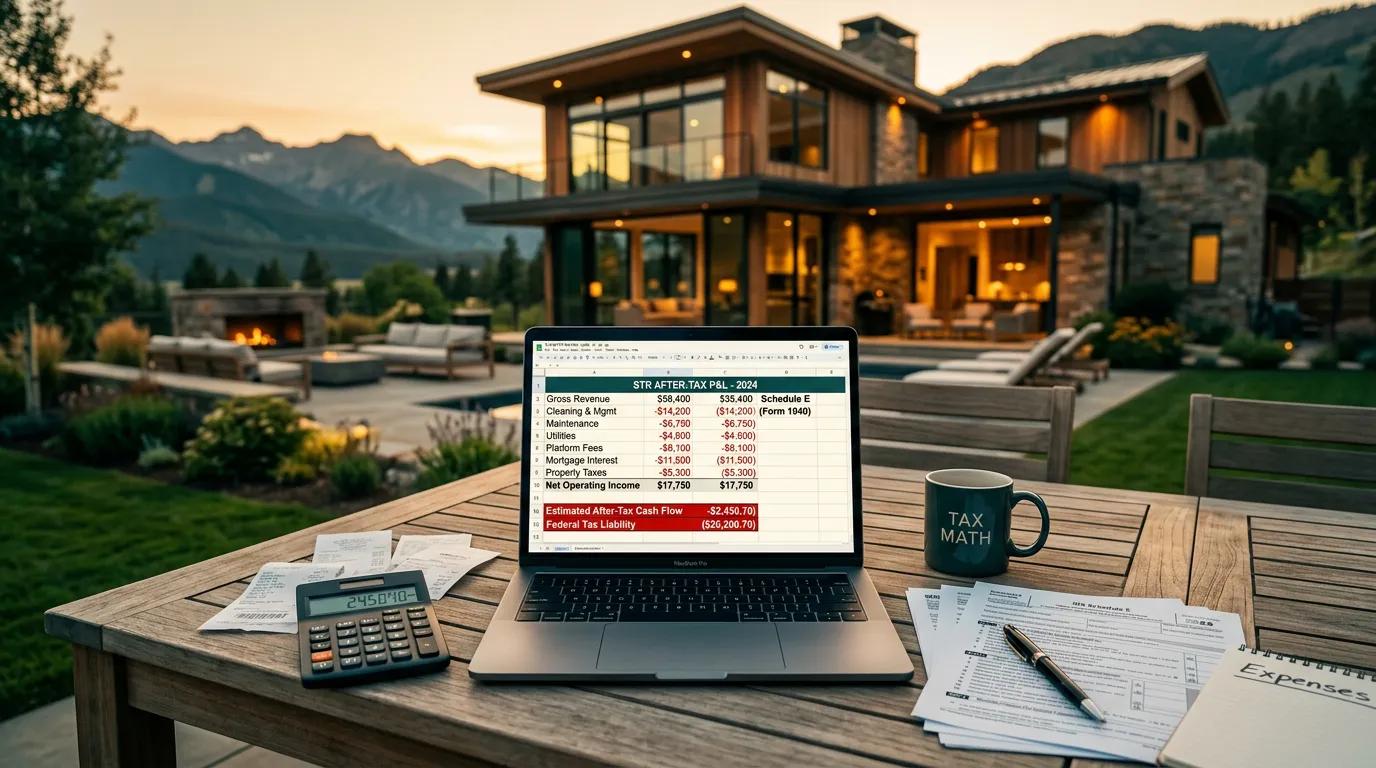
Every STR investor I've ever met can tell you their gross revenue to the penny.
"$48,000 last year." "$6,200 a month." "$312 average nightly rate."
Ask them their after-tax, after-fee, after-recapture net profit and you get silence. Or a number that's wrong by $15,000–$40,000.
This isn't because STR investors are bad at math. It's because the tax system for short-term rentals is a maze of classifications, elections, and traps that interact in ways nobody explains in a single place. Your gross revenue passes through at least six filters before it becomes money you actually keep — and most hosts have never mapped all six.
This article maps all six. With real numbers, on a real property, through every tax layer.
Author's note (Overline): We deliver cost segregation studies for short-term rental properties. We benefit when STR investors accelerate depreciation. So why publish an article showing how thin STR margins can be? Because the investors who understand the full tax picture make better decisions — they structure correctly, they time their studies right, and they don't get blindsided at sale. The ones who don't understand it call us angry in year three.
The Property: A Real-World STR Example
Let's use a property that represents the typical STR investor — not a luxury cabin in the Smokies, not a beachfront mansion, but the kind of property most hosts actually own.
| Detail | Value |
|---|---|
| Purchase price | $425,000 |
| Land value | $85,000 (20%) |
| Depreciable basis | $340,000 |
| Furnishing cost | $35,000 |
| Location | Mid-market vacation area |
| Average nightly rate | $225 |
| Occupancy | 68% (248 nights/year) |
| Average stay | 4.2 days (qualifies as STR) |
| Gross booking revenue | $55,800/year |
| Owner's W-2 income | $350,000 |
| Filing status | Married filing jointly |
Looks like a solid investment. $55,800 in revenue on a $425K property. Let's see what's actually left.
Filter #1: Platform Fees and Operating Expenses
This is the layer most hosts track. It's also the layer where the bleeding starts.
| Expense | Annual Cost | Notes |
|---|---|---|
| Airbnb host fee (3%) | $1,674 | On gross booking subtotal |
| Cleaning (per turnover) | $7,400 | ~$125 × 59 turnovers |
| Property management software | $1,200 | PriceLabs, Hospitable, etc. |
| Utilities (above normal) | $3,600 | Electric, water, internet, streaming |
| Supplies & consumables | $2,400 | Toiletries, linens replacement, kitchen items |
| Maintenance & repairs | $3,500 | HVAC filters, plumbing, appliance fixes |
| Insurance (STR policy) | $2,800 | Commercial STR coverage — standard homeowner's won't cover you |
| Property tax | $4,200 | Varies by jurisdiction |
| HOA / landscaping | $1,800 | If applicable |
| Mortgage interest | $18,000 | On $340K loan at 6.5% |
| Mortgage principal | $4,800 | Not deductible — but still cash out of pocket |
| Total cash expenses | $51,374 |
Cash flow before taxes: $55,800 − $51,374 = $4,426/year.
That's $369/month. Before a single dollar of tax.
Most hosts stop here and think: "Well, at least I'm cash-flow positive. And I'm building equity. And I get depreciation."
All true. But the tax layers are where the real surprises live.
Filter #2: The Schedule C vs. Schedule E Trap
Here's where most STR hosts make their first major mistake — and it's worth thousands of dollars per year.
The rule: If your average guest stay is 7 days or less, the IRS classifies your STR as a business, not a rental activity. This has two massive consequences:
Consequence 1: You report on Schedule C, not Schedule E.
Schedule C income is subject to self-employment tax at 15.3% (12.4% Social Security + 2.9% Medicare). Schedule E income is not.
On $55,800 in gross revenue minus deductible expenses, your net Schedule C income might be $20,000–$25,000. At 15.3%, that's $3,000–$3,800 in self-employment tax that a long-term rental investor would never pay.
Consequence 2: The classification can work FOR you.
The same 7-day classification that triggers self-employment tax is what makes the STR loophole work. Because your STR is a "business" and not a "rental activity," it's exempt from passive activity rules — meaning your losses can offset W-2 income if you materially participate.
The trap: Many hosts don't realize these two things are connected. They want the STR loophole (losses offset W-2) but don't want Schedule C (self-employment tax). You can't have one without the other.
| Classification | Schedule | SE Tax? | Losses Offset W-2? | Average Stay |
|---|---|---|---|---|
| STR (< 7 days avg) | C | Yes (15.3%) | Yes, with material participation | < 7 days |
| MTR (7-30 days, no services) | E | No | No (passive) | 7-30 days |
| LTR (> 30 days) | E | No | No (passive) | > 30 days |
What most hosts miss: An S-Corp election can reduce self-employment tax by paying yourself a "reasonable salary" and taking the rest as distributions. But this adds complexity, payroll costs, and only makes sense above ~$40K in net STR income. For our example property, the juice probably isn't worth the squeeze.
Filter #3: The Depreciation Schedule You're Probably Getting Wrong
Here's an obscure rule that costs STR owners thousands and almost nobody talks about:
Short-term rental properties depreciate over 39 years, not 27.5 years.
Why? The IRS defines "residential rental property" as property where tenants stay for extended periods. When your average guest stay is 30 days or less, your property is classified as nonresidential — the same category as office buildings and retail stores. That means 39-year straight-line depreciation instead of 27.5.
| Property Type | Average Stay | Depreciation Period | Annual Straight-Line Deduction (on $340K basis) |
|---|---|---|---|
| Long-term rental | > 30 days | 27.5 years | $12,364 |
| Short-term rental | ≤ 30 days | 39 years | $8,718 |
| Difference | $3,646 less per year |
Over a 10-year hold, that's $36,460 in lost depreciation if you're using straight-line only. And many CPAs file STR properties at 27.5 years because they don't know the rule — which creates an incorrect return that could trigger issues later.
The fix: Cost segregation eliminates this problem. When you reclassify components to 5, 7, and 15-year schedules with 100% bonus depreciation for property acquired after January 19, 2025, the difference between 27.5 and 39 years on the remaining structure becomes much less significant, because you've already front-loaded the majority of your deductions.
Filter #4: Cost Segregation — The Lever That Changes Everything (If You Can Use It)
Let's run cost segregation on our example property.
Without cost segregation:
| Component | Basis | Schedule | Year 1 Deduction |
|---|---|---|---|
| Building (39-year) | $340,000 | Straight-line | $8,718 |
| Furnishings (5-year) | $35,000 | 100% bonus | $35,000 |
| Total Year 1 | $43,718 |
With cost segregation:
| Component | Basis | Schedule | Year 1 Deduction |
|---|---|---|---|
| 5-year property | $54,400 (16% of basis) | 100% bonus | $54,400 |
| 7-year property | $17,000 (5% of basis) | 100% bonus | $17,000 |
| 15-year property | $44,200 (13% of basis) | 100% bonus | $44,200 |
| Remaining structure (39-year) | $224,400 | Straight-line | $5,754 |
| Furnishings (5-year) | $35,000 | 100% bonus | $35,000 |
| Total Year 1 | $156,354 |
That's a $112,636 difference in first-year deductions. At a 35% marginal rate, that's $39,423 in additional tax savings — in year one alone.
But here's the critical question: can you actually USE those deductions?
If you materially participate in your STR (the STR loophole), those $156,354 in deductions offset your $350,000 W-2 income. Tax savings: ~$54,724 in year one.
If you DON'T materially participate, those losses are passive. They sit in a suspended loss bucket on Form 8582 until you generate passive income or sell the property. The cost segregation study still has value — but you can't use it against your W-2 income.
The material participation requirement for STRs:
You need to pass ONE of the seven IRS tests. The most common for STR operators:
- 500-hour test: Participate 500+ hours in the STR activity during the year (~10 hrs/week)
- 100-hour / no-one-more test: Participate 100+ hours AND no one else participates more than you
- Substantially all test: You do substantially all the work (no property manager)
If you use a full-service property manager, you almost certainly fail material participation. Self-managing hosts who handle guest communication, pricing, turnover coordination, and maintenance typically pass — but you need to document your hours.
For the full breakdown of STR loophole vs. REPS: Which Tax Strategy Works for You?
Filter #5: The Recapture Time Bomb at Sale
Every dollar of depreciation you claim reduces your adjusted basis. When you sell, the IRS recaptures that depreciation at a 25% rate (Section 1250 recapture) — regardless of your ordinary income tax bracket.
Let's model our example property sold after 5 years:
Scenario A: No cost segregation, straight-line only
| Item | Amount |
|---|---|
| Purchase price | $425,000 |
| Total depreciation (5 years) | $43,590 + $35,000 furnishings = $78,590 |
| Adjusted basis | $346,410 |
| Sale price (3% annual appreciation) | $492,700 |
| Total gain | $146,290 |
| Depreciation recapture (25%) | $19,648 |
| Capital gains (15%) | $10,157 |
| Total tax at sale | $29,805 |
Scenario B: Cost segregation + bonus depreciation
| Item | Amount |
|---|---|
| Purchase price | $425,000 |
| Total depreciation (5 years) | $156,354 (yr 1) + $5,754 × 4 = $179,370 |
| Adjusted basis | $245,630 |
| Sale price (3% annual appreciation) | $492,700 |
| Total gain | $247,070 |
| Depreciation recapture (25%) | $44,843 |
| Capital gains (15%) | $10,157 |
| Total tax at sale | $55,000 |
The recapture difference: $25,195 more tax at sale with cost segregation.
But during the hold period, cost segregation generated ~$39,423 more in tax savings in year one alone — money that was invested and compounding for 5 years.
Net present value analysis (assuming 8% return on reinvested savings):
| Metric | No Cost Seg | With Cost Seg | Difference |
|---|---|---|---|
| Year 1 tax savings | $15,301 | $54,724 | +$39,423 |
| Reinvested value after 5 years (8%) | $22,487 | $80,413 | +$57,926 |
| Additional tax at sale | — | $25,195 | −$25,195 |
| Net benefit of cost seg | +$32,731 |
Cost segregation wins by $32,731 on a $425K property over 5 years — even after recapture. The longer you hold, the wider the gap.
But if you sell in year 2? The math flips. You've only had 1-2 years of compounding on the tax savings, but you face the full recapture. Short holds are where cost segregation can be net-negative.
Exit strategies that eliminate recapture:
- 1031 exchange — defer gain and recapture into a replacement property
- Hold until death — heirs get stepped-up basis, recapture disappears
- Installment sale — spread gain over multiple years
For the full exit analysis: Why Most Real Estate Tax Strategies Fail at Exit
Filter #6: State Taxes, Local STR Taxes, and the Fees Nobody Budgets For
The federal math is only part of the picture. Depending on where your STR is located, state and local taxes can take another significant bite.
State income tax on STR profits:
| State | Top Rate | Impact on $55K Gross STR |
|---|---|---|
| California | 13.3% | Significant — and CA doesn't conform to federal bonus depreciation |
| New York | 10.9% | Plus NYC local tax if applicable |
| Texas | 0% | No state income tax — but franchise tax may apply |
| Florida | 0% | No state income tax |
| Tennessee | 0% | No state income tax on earned income |
| Colorado | 4.4% | Flat rate |
Local STR taxes and fees:
Many jurisdictions impose occupancy taxes, tourism taxes, or STR-specific permit fees that Airbnb may or may not collect automatically:
- Occupancy/transient tax: 6%–15% of gross revenue (often collected by Airbnb, but not always)
- STR permit/license fees: $50–$2,000/year depending on jurisdiction
- Business license: $50–$500/year
- Fire/safety inspection: $100–$300
California-specific trap: California does not conform to the federal 100% bonus depreciation allowance for property acquired and placed in service after January 19, 2025. If your STR is in California, you get the federal benefit but must add back the bonus depreciation on your state return and depreciate normally. This creates a significant state tax bill that offsets part of your federal savings. See our California tax strategies guide.
The Full Picture: What $55,800 in Gross Revenue Actually Becomes
Let's put it all together for our example property, assuming the owner materially participates (STR loophole) and does cost segregation:
| Layer | Amount | Running Total |
|---|---|---|
| Gross booking revenue | $55,800 | $55,800 |
| Platform fees | −$1,674 | $54,126 |
| Operating expenses (cleaning, utilities, supplies, maintenance) | −$18,900 | $35,226 |
| Insurance | −$2,800 | $32,426 |
| Property tax | −$4,200 | $28,226 |
| Mortgage interest (deductible) | −$18,000 | $10,226 |
| Mortgage principal (not deductible, but cash out) | −$4,800 | $5,426 |
| Pre-tax cash flow | $5,426 | |
| Tax impact (Year 1 with cost seg + STR loophole): | ||
| Depreciation deduction (cost seg + furnishings) | −$156,354 | |
| Net tax loss (deductions exceed income) | −$150,928 | |
| Tax savings at 35% marginal rate | +$52,825 | |
| Self-employment tax (Schedule C, ~15.3% on net) | −$3,200 | |
| Net tax benefit | +$49,625 | |
| Year 1 total economic benefit | $55,051 |
The punchline: The $55,800 STR generates only $5,426 in actual cash flow. The real money — $49,625 — comes from the tax benefit. Without cost segregation and the STR loophole, the tax benefit drops to ~$5,000, and the total economic benefit is barely $10,000.
Year 2+ reality check: The cost segregation benefit is heavily front-loaded. In year 2, your depreciation drops to ~$5,754 (just the remaining 39-year structure). Your tax benefit drops from $49,625 to roughly $5,000. The property needs to cash-flow on its own merits from year 2 onward.
The 7 Mistakes That Destroy STR After-Tax Returns
Based on everything above, here's what actually kills STR profitability:
| # | Mistake | Cost |
|---|---|---|
| 1 | Using 27.5-year depreciation instead of 39-year | Incorrect return, potential audit adjustment |
| 2 | Not doing cost segregation | Missing $39K+ in year-1 tax savings |
| 3 | Failing material participation | $49K in losses become suspended and unusable |
| 4 | Ignoring self-employment tax | $3,000–$5,000/year in unexpected SE tax |
| 5 | Not modeling recapture before buying | $25K–$50K surprise tax bill at sale |
| 6 | California bonus depreciation add-back | State tax bill offsets federal savings |
| 7 | Using a property manager and claiming STR loophole | IRS denies material participation — all losses suspended |
What to Do With This Information
If you're considering buying an STR: Run the full six-filter analysis before you buy. The gross revenue number is meaningless without it. Use our cost segregation calculator to model the depreciation benefit, then layer in your actual operating expenses, tax bracket, and state taxes.
If you already own an STR and haven't done cost segregation: You're leaving the biggest tax benefit on the table. And if you've owned for multiple years, a look-back study with Form 3115 can capture all the missed depreciation in a single year.
If you're using a property manager and claiming the STR loophole: Stop and reassess. If you can't prove material participation, your losses are passive — and claiming otherwise is an audit risk. Either self-manage enough to pass the 500-hour test, or explore REPS as an alternative path.
If you're planning to sell within 1-2 years: Model the recapture carefully. Cost segregation may still be net-positive, but the margin is thin on short holds. Consider whether a 1031 exchange makes sense for your situation.
Q: Is my short-term rental depreciated over 27.5 or 39 years?
A: If your average guest stay is 30 days or less, the IRS classifies your property as nonresidential, and it depreciates over 39 years. This is based on the "transient use" definition — properties used on a short-term basis don't qualify as "dwelling units" under IRC §168(e)(2). Many CPAs get this wrong. If your return shows 27.5 years on an STR, it may need correction via Form 3115.
Q: Do I owe self-employment tax on my Airbnb income?
A: It depends on the services you provide. If you offer substantial services beyond basic cleaning between guests — things like daily housekeeping, meals, concierge services, or guided experiences — your income is reported on Schedule C and subject to 15.3% self-employment tax. If you provide only basic landlord services (cleaning between stays, providing linens, maintaining the property), you may report on Schedule E without self-employment tax. The 7-day average stay rule also factors in. Consult a CPA who specializes in STR taxation.
Q: Can I use cost segregation on a short-term rental?
A: Absolutely. STRs are one of the highest-ROI use cases for cost segregation because (a) the STR loophole allows you to use the losses against W-2 income with material participation, and (b) for property acquired and placed in service after January 19, 2025, the 100% allowance under the One Big Beautiful Bill Act makes the first-year benefit massive. The key is confirming you can actually use the deductions, which requires material participation documentation.
Q: What happens to my STR tax benefits if I switch to a property manager?
A: If a property manager handles day-to-day operations and you can no longer prove material participation, your STR losses become passive. They can only offset passive income — not your W-2. The cost segregation deductions still exist, but they're suspended until you generate passive income or sell the property. This is one of the most common ways investors accidentally kill their tax strategy.
Q: Is it too late to do cost segregation on an STR I bought 3 years ago?
A: No. You can do a look-back study and file Form 3115 to claim the cumulative catch-up adjustment on your current-year return. The IRS treats this as an automatic change in accounting method — no advance approval needed. All the accelerated depreciation you should have taken in prior years hits your return in a single year. See our full guide on look-back studies.
For a quick cost segregation estimate, try Modern CFO's free calculator. For cost segregation benchmark data and savings analysis, see Modern CFO's cost segregation benchmark data.
See Your Property's Tax Savings
Drop your address. The AI estimates your depreciation savings in 60 seconds, backed by a certified engineer study.

Free cost segregation estimate, engineer-certified studies, and ongoing depreciation tracking.
Backed by $1B+ in supported tax depreciation.